DSCR Loan: What Real Estate Investors Need to Know
A DSCR loan is a mortgage that qualifies you based on the property's rental income rather than your personal income; the lender evaluates whether the property's cash flow covers the debt payments, not whether your W-2 or tax returns support the loan.
How DSCR Loans Work
Traditional mortgages require income documentation: pay stubs, W-2s, two years of tax returns, and debt-to-income (DTI) calculations. If you're self-employed, own multiple properties, or write off income aggressively, qualifying gets complicated.
DSCR loans skip personal income entirely. Instead, the lender calculates:
DSCR = Property's Monthly Rental Income ÷ Monthly Debt Payment (PITIA)
PITIA = Principal + Interest + Taxes + Insurance + Association dues
Example:
- Monthly rent: $2,200
- Monthly PITIA: $1,760
- DSCR: $2,200 ÷ $1,760 = 1.25
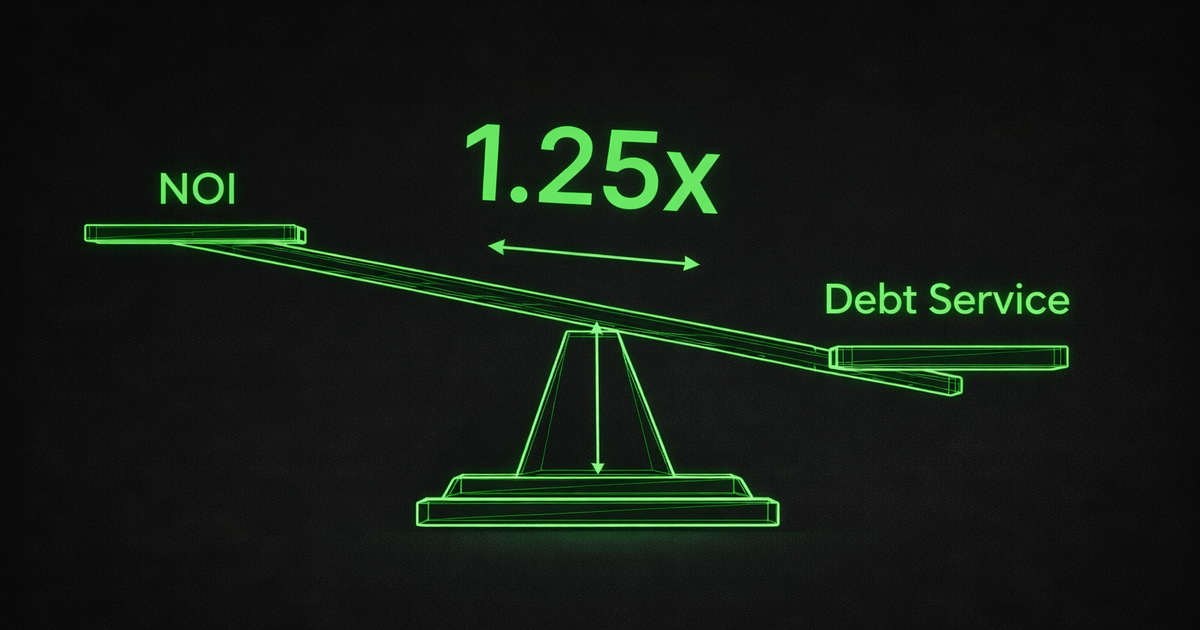
A 1.25 DSCR means the property generates 25% more income than the mortgage payment. Most lenders require 1.0-1.25 minimum.
DSCR Loan Requirements
Minimum DSCR
Pro tip: A DSCR of 1.0 means the property breaks even on paper. Lenders allowing sub-1.0 DSCR assume you'll cover shortfalls from other income. Expect to pay for that risk.
Down Payment
DSCR loans typically require 20-25% down. Some lenders offer 15% down for strong DSCR (1.25+), while sub-1.0 DSCR may require 30-35% down.
Credit Score
Most DSCR lenders require 660+ credit. Premium rates start at 720+. Below 660, options are limited and expensive.
Property Types
DSCR loans work for:
- Single-family rentals (SFR)
- 2-4 unit properties
- Condos (warrantable)
- Townhomes
- 5+ unit multifamily (some lenders)
- Short-term rentals (some lenders, and they'll use AirDNA projections instead of lease)
They typically don't work for:
- Primary residences
- Raw land
- Commercial properties (retail, office, industrial)
- Properties in poor condition
Reserves
Expect to show 6-12 months of PITIA in liquid reserves. Lenders want assurance you can cover payments if the property goes vacant. For context on how lenders also use debt yield alongside DSCR, see our dedicated guide.
DSCR Loan Rates and Costs
DSCR loans carry higher rates than conventional mortgages, typically 1-2% higher.
Current market (as of early 2024):
- Conventional investment property (25% down): 7.0-7.5%
- DSCR loan (25% down, 1.25+ DSCR): 7.5-8.5%
- DSCR loan (25% down, 1.0 DSCR): 8.0-9.0%
- DSCR loan (25% down, sub-1.0 DSCR): 8.5-10.0%
Additional costs:
- Origination fees: 1-2% of loan amount
- Prepayment penalties: Often 3-5 years (3-2-1 or 5-4-3-2-1 step-down)
- Higher closing costs overall
The rate premium is the cost of convenience. You're paying to skip income documentation and underwrite faster.
When DSCR Loans Make Sense
You're self-employed or have complex income
If your tax returns show $80,000 income but you actually gross $200,000 (after write-offs), conventional underwriters see $80,000. You won't qualify for much. DSCR lenders don't care what your tax return says.
You own 5+ financed properties
Conventional lenders cap you at 10 financed properties. After that, DSCR is one of your only options for 30-year fixed financing.
I hit the conventional wall at property #7. My DTI was maxed even though my portfolio cash flowed $8,000/month. DSCR loans let me keep acquiring without selling existing properties.
You want faster closing
DSCR loans close in 2-3 weeks versus 30-45 days for conventional. Less documentation = faster underwriting. This matters when competing against cash buyers on good deals.
The property qualifies but you don't
Some investors have high income but also high debt: other mortgages, business loans, car payments. DTI kills their conventional options even though the target property cash flows beautifully. DSCR sidesteps personal DTI entirely.
When DSCR Loans Don't Make Sense
You easily qualify conventional
If you're buying properties 1-4, have clean W-2 income, and conventional rates are 1.5% lower, take the conventional loan. The rate savings compound over 30 years.
Example: On a $200,000 loan, 7% vs 8.5% = $200/month difference. Over 30 years, that's $72,000 extra in interest.
The property barely cash flows
A 0.9 DSCR property with an 8.5% rate is cash flow negative from day one. You're betting purely on appreciation. Make sure you're comfortable covering the monthly shortfall indefinitely.
You need a sub-20% down payment
DSCR loans require 20%+ down. If you're stretching for down payment and need 15% or 10%, conventional (properties 1-4) or FHA house hacking are better options.
DSCR Loan Process
- Get pre-qualified. Provide property address, estimated rent, purchase price, credit score. Lender gives preliminary rate and terms.
- Submit application. Minimal documentation: ID, bank statements (for reserves), entity documents if buying in LLC.
- Property valuation. Lender orders appraisal plus rent schedule (comparable rent analysis). This determines both value and DSCR.
- Underwriting. Lender verifies property qualifies based on DSCR, LTV, and condition. Typically 7-14 days.
- Close. Sign documents, fund loan, take ownership.
Total timeline: 14-21 days for experienced borrowers.
Calculating DSCR Before You Apply
Run the numbers yourself before talking to lenders. A cash flow analysis will tell you whether the property supports DSCR financing:
Monthly rental income: Use actual lease amount, or comparable rents if vacant. Be conservative; lenders use their own rent schedule.
Monthly PITIA:
- Principal + Interest: Use a mortgage calculator at estimated rate
- Taxes: Annual property tax ÷ 12
- Insurance: Annual premium ÷ 12
- HOA: Monthly dues if applicable
DSCR = Rent ÷ PITIA
If you're below 1.0, either the property doesn't work for DSCR financing, or you need a larger down payment to reduce the mortgage payment.
Track your portfolio's DSCR across all properties with Operator. When rates drop and refinancing makes sense, you'll know exactly which properties qualify.
FAQ
What is a DSCR loan?
A DSCR (Debt Service Coverage Ratio) loan is an investment property mortgage that qualifies borrowers based on the property's rental income rather than personal income. The lender calculates whether the property's rent covers the mortgage payment; if DSCR is 1.0 or higher, the property services its own debt and may qualify regardless of the borrower's W-2 or tax returns.
What DSCR is required for a loan?
Most DSCR lenders require minimum 1.0-1.25 DSCR. A 1.25 DSCR (property earns 25% more than the mortgage payment) gets the best rates. Some lenders allow 0.75-0.99 DSCR with higher down payments and rates. Below 0.75 DSCR is difficult to finance.
Are DSCR loan rates higher than conventional?
Yes. DSCR loans typically carry rates 1-2% higher than conventional investment property mortgages. As of early 2024, conventional investment property rates are 7.0-7.5%, while DSCR rates range from 7.5-9.0% depending on DSCR ratio, credit score, and down payment. The rate premium compensates for reduced documentation and faster underwriting.
Built for this
Operator runs every metric in this article automatically. Add a property, and you'll see cap rate, cash-on-cash, DSCR, and NOI in seconds — not hours. Your deal library saves every analysis so nothing gets lost.