House Hacking Doesn't Cash Flow at 7% Rates. Here's Why People Still Do It.
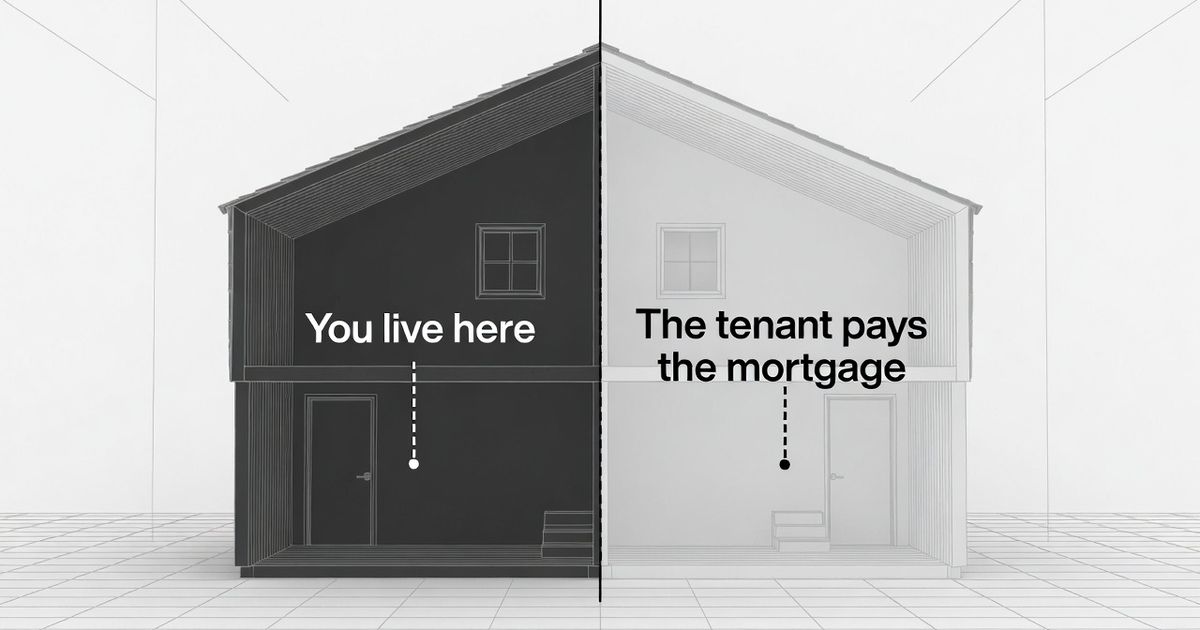
House hacking is an investment strategy where you live in one unit of a multi-unit property (or one room of a single-family home) while renting out the rest to cover your mortgage, often reducing your housing cost to zero while building equity in a real asset. It's the lowest-barrier entry point into real estate investing because you can buy with 3.5% down (FHA) instead of the 20-25% required for a pure investment property.
That's the pitch. Here's the part nobody tells you upfront.
The Uncomfortable Math
Buy a duplex in Indianapolis for $285,000. Live in one unit. Rent the other for $1,250/month. Your total housing payment (P&I + taxes + insurance + MIP) is $2,426/month. After operating expenses on the tenant unit, your net housing cost is $1,715/month.
Now the part that makes house hacking influencers uncomfortable: after you move out and rent both units, here's what this duplex looks like as a pure investment.
Negative $639 a month. Even self-managed, you're at -$431.
At current rates with FHA financing, this duplex bleeds money as a rental. You'd need rent appreciation of roughly 15% across both units just to break even with a property manager. This is common in 2026, not an outlier, not a bad deal, just what the math looks like when rates are 7% and you put 3.5% down.
So why do 22-year-olds keep buying duplexes?
Because house hacking isn't a cash flow strategy. It's a wealth-building strategy that happens to slash your housing costs while you're living there. And the numbers, once you look at them correctly, are compelling even when the property doesn't cash flow on its own.
What the Strategy Actually Returns
Forget cash flow for a minute. Compare three scenarios over five years: renting an apartment, buying a single-family home to live in, and house hacking a duplex.
House hacking puts you $93,900 ahead of renting and $42,660 ahead of traditional homeownership over five years.
And you only needed $18,525 to get started.
The return isn't monthly cash flow, cash-on-cash return is just one lens. The real return is that you controlled a $285,000 asset with less than $19,000 down, someone else paid most of your mortgage, and five years later you own a building with $65,000+ in equity. Every dollar of rent your tenant paid was a dollar you didn't spend on housing and a dollar that went toward owning the building outright.
That's the trade. You live next to a tenant for 12-18 months. In exchange, you skip five years of wealth-building that most people don't start until their 40s.
The Four Models (Ranked by Return, Then by Lifestyle Pain)
1. Small Multifamily: Duplex, Triplex, Fourplex
Live in one unit, rent the others. Separate entrances, separate lives.
A fourplex can generate $3,500-5,000/month in rent from three units while you occupy the fourth. At $4,200/month in rental income against a $2,800 mortgage, your housing cost goes negative, you're getting paid to live there. This is increasingly rare at current rates, but it exists in Midwest markets where purchase prices haven't caught up to rent growth.
The real advantage isn't the income. It's the financing. Properties with 1-4 units qualify for residential loans: 3.5% down FHA, 5% down conventional. Not the 20-25% required for investment properties (or the higher-rate DSCR loans many investors use after their 5th property). This single fact is why house hacking exists as a strategy, the capital efficiency is unmatched.
2. Rent-by-the-Room
Buy a 4-bedroom house. Live in one room, rent three at $750 each. $2,250/month from a single-family home.
Per-room rents run 25-40% higher than whole-unit rents on a per-square-foot basis. The math is better. The lifestyle is worse. You're sharing a kitchen with people who are paying you rent, and that dynamic works until it doesn't.
Works best near universities or in high-cost metros where room rentals are normal. Know whether you can tolerate shared living before you buy. Some people genuinely don't mind. Others hate it within a month and now they own a house optimized for a strategy they've abandoned.
3. Single-Family with ADU
House with a detached garage apartment, basement unit, or backyard ADU. Live in the main house, rent the ADU for $800-1,500/month.
Less income than a duplex. But you get a full house to yourself, no shared walls, no shared anything. For people who want some rental income without any tenant proximity, this is the compromise.
4. Short-Term Rental Hybrid
Live there most of the time, Airbnb it when you travel. A weekend away generates $200-600 in tourist markets.
Lowest commitment, lowest income. Works for unique properties (cabins, downtown lofts) in vacation areas. Not a wealth-building strategy on its own, more of a side benefit for people who travel frequently and happen to own something interesting.
The Full Deal: Indianapolis Duplex at 2026 Rates
Let me walk through every number so you can see exactly where the money goes.
The property
- Purchase price: $285,000
- Unit A (you live here): 3bd/1ba, market rent $1,350/month
- Unit B (tenant): 2bd/1ba, rented at $1,250/month
Financing: FHA Loan
Loan amount: $285,000 - $9,975 + $4,988 = $280,013
Monthly costs
Operating expenses on tenant unit
Your net housing cost
$1,250 rental income - $2,426 PITI - $539 operating = -$1,715/month
That's $485/month less than the $2,200 you'd pay renting a comparable apartment. Not free housing. But $5,820/year in savings plus equity accumulation on a $285,000 asset you bought with $18,525.
The Move-Out Playbook
After 12 months (FHA minimum), you move out and rent Unit A at market ($1,350). Now both units produce income. The duplex becomes a pure rental, and as we showed above, it's cash flow negative at current rates.
This is normal. Don't panic. Here's why it still works.
Your tenants are paying $2,600/month toward a building you control. Even at -$431/month self-managed, you're accumulating $19,200 in principal paydown over the next five years and riding $45,000+ in appreciation (at 3%/year). The negative cash flow is the cost of holding an appreciating, leveraged asset with 96.5% financing. That's a cost many investors are willing to pay, especially when the alternative was putting 25% down on an investment property that might cash flow $200/month.
The repeatable version
- Year 1: Buy duplex with FHA (3.5% down), live in one unit
- Year 2: Move out, rent both units, buy another property with conventional owner-occupied (5% down)
- Year 3-4: Repeat with conventional financing
- Year 5: You own 3-4 properties acquired with 3.5-5% down each
After 5 years, you might control $1M+ in real estate with under $80,000 total out of pocket. That's how you build a real estate portfolio from scratch. Good luck achieving that capital efficiency with any other investment vehicle.
FHA specifics worth knowing
FHA loan limits vary by county: $498,257 in most areas, up to $1,149,825 in high-cost markets (for duplexes, single-family limits are lower). You can only have one FHA loan at a time. Must be primary residence for minimum 12 months. FHA charges upfront MIP (1.75% of loan) plus annual MIP (0.55%) for the life of the loan, and that last part matters. You're paying an extra $128/month on this deal forever unless you refinance into conventional, which requires 20%+ equity.
Operator pulls live rent comps for any address, so you know what each unit will actually rent for before you make an offer. The difference between a good house hack and a regrettable one is $200/month in rent accuracy. $25/mo.
When to Skip It
You have kids who need space. Sharing walls with tenants works for singles and couples. A household with two children needs privacy and dedicated outdoor space. A duplex where your kids' bedroom shares a wall with a stranger's living room creates friction fast.
Your market is too expensive. San Francisco median duplex: $1.4M+. Manhattan: $2M+. The math doesn't work unless household income is $300K+. House hacking is a strategy for markets where small multifamily exists under $400,000.
You can't separate personal and business. Being a landlord is manageable. Being a landlord who lives 10 feet from your tenant is harder. Every late-night noise complaint is personal. Every maintenance request feels urgent when you can see the leak from your window. Some people handle this naturally. Others need more separation than a shared wall provides.
The property doesn't pencil. A $450,000 duplex with $1,200 rent per side is not a house hack, it's an expensive primary residence with an upstairs neighbor. If the housing cost reduction is less than $300/month compared to renting, the hassle of live-in landlording probably isn't worth it. Run the numbers first using a rental property calculator.
House Hacking vs. Everything Else
House hacking wins on capital efficiency. Nothing else lets you control a $285,000 asset with $18,500 down while simultaneously cutting your housing costs. The trade-off is 12-18 months of proximity to your tenants. For most people in their 20s and early 30s without kids, that trade is obviously worth making.
Whether you're house hacking your first duplex or managing a 10-property portfolio, Operator tracks every property against live market data. See what each unit should rent for, calculate your cash flow, and know when it's time to raise rents. $25/mo.
FAQ
How much can you save by house hacking?
$500-1,500/month compared to renting or owning a single-family home. In strong rental markets with affordable small multifamily, house hacking can eliminate housing costs entirely. Over 5 years, the strategy typically builds $40,000-95,000 more net wealth than renting, the gap depends on local appreciation, rental income, and how quickly you scale to multiple properties.
Can you house hack with an FHA loan?
Yes: and most first-time house hackers do. FHA requires 3.5% down on 1-4 unit properties as long as you live in one unit as primary residence for at least 12 months. The trade-off is mandatory mortgage insurance: 1.75% upfront plus 0.55% annually for the life of the loan. On a $285,000 duplex, that adds about $128/month. You can refinance into conventional to drop MIP once you have 20%+ equity, but at current rates, many house hackers are underwater on that math for the first 3-5 years.
Is house hacking worth it in 2026?
As a wealth-building strategy, yes. As a cash flow strategy, rarely. At 7%+ rates, most house-hacked duplexes won't generate positive cash flow after you move out. The return comes from three places: housing cost reduction ($500-1,500/month savings versus renting), equity accumulation through appreciation and principal paydown, and portfolio building with minimal capital. If you're waiting for a house hack that cash flows at today's rates, you're waiting for a property that probably doesn't exist at median prices.
What is the best property type for house hacking?
Duplexes. Full unit to yourself, separate entrance, enough rent to meaningfully reduce your mortgage, and they qualify for residential financing. Fourplexes generate more income but cost more, are harder to find, and require managing three tenant relationships. Rent-by-room maximizes income per dollar but means living with strangers. Start with a duplex unless you have a specific reason not to.
How does Operator help with house hacking?
Operator pulls live rent comps for any address so you can verify what each unit will actually rent for before making an offer. After purchase, it monitors your rental units against market and alerts you when rents fall below comparable properties, important because the house hack math depends entirely on accurate rent assumptions. $25/month.
Built for this
Operator runs every metric in this article automatically. Add a property, and you'll see cap rate, cash-on-cash, DSCR, and NOI in seconds — not hours. Your deal library saves every analysis so nothing gets lost.