Rental Property Calculator: Formulas, Worked Example, and Mistakes
A rental property calculator estimates your monthly cash flow, cash-on-cash return, and total ROI by comparing a property's expected rental income against its purchase price, financing costs, and operating expenses, and the fastest way to understand how it works is to watch one run on a real deal.
A $250K Duplex Hits Your Inbox. Here's What Happens Next.
A two-unit property in a B-class neighborhood. Listed at $250,000. Unit A rents for $1,500/month, Unit B for $1,400. $2,900 gross. Looks solid on Zillow.
You're going to spend the next 10 minutes proving whether that's true or whether you'd be writing $200 checks to your mortgage company every month for the privilege of owning it. Here's the full analysis, every line item visible.
What you're putting in
What it earns
Why 8% vacancy instead of the 5% baked into every online calculator? Because 5% assumes you fill every unit within 18 days of turnover, every time, zero rent-free concessions, zero make-ready overlap. In the real world, a turnover takes 3-4 weeks and costs $500-1,500 in cleaning and minor repairs before the next tenant moves in. Use 8%. If actual vacancy comes in lower, that's upside you didn't need.
What it costs to operate
*Include management even if you self-manage. Your time has a cost, and the day you want to step back from operations or sell this as a performing asset, the real cash flow is the number with management baked in. Calculating ROI on your own free labor isn't analysis, it's a story you're telling yourself.
The verdict
$278/month. 5.1% cash-on-cash. That's where most people stop, positive cash flow, green light, submit the offer.
Don't.
5.1% cash-on-cash means your $65,000 is earning less per year than a high-yield savings account would generate with zero risk, zero tenants, zero midnight plumbing calls. The total ROI of 8.2% (once you include principal paydown) looks better, but cash-on-cash is what keeps the lights on month to month. And 5.1% leaves you one bad turnover away from feeding this property out of pocket.
This deal is thinner than it looks on paper. For a step-by-step walkthrough of every expense line, see our guide on how to analyze a rental property. Now let's talk about the formulas behind each number, because once you understand them, you'll spot the thin deals before you ever open a spreadsheet.
The Four Formulas (and What Each One Actually Tells You)
NOI: What the property earns before your loan exists
NOI = Gross Scheduled Rent - Vacancy Loss - Operating Expenses
NOI isolates the property's performance from your financing. A lender uses this number to decide how much to lend you. You should use it to decide whether the property itself is productive, regardless of how you're paying for it.
Two investors can buy the same building. One pays cash, one puts 20% down. Same NOI. Wildly different cash flow. NOI tells you about the building. Cash flow tells you about the deal.
Operating expenses include property taxes, insurance, management (8-10% of gross rent), maintenance reserve (5% of gross rent), CapEx reserve (5-10% of gross rent), HOA fees, and any owner-paid utilities. NOI does not include mortgage payments.
Cash flow: What hits your bank account
Monthly Cash Flow = (NOI / 12) - Monthly Debt Service
Debt service is your mortgage principal + interest. If you buy with cash, cash flow equals NOI divided by 12 and congratulations on your liquidity.
A property can have a strong NOI but negative cash flow if you over-leveraged the purchase. This is increasingly common at 7%+ rates, the building performs fine, but the debt load drowns the returns. When you see a property with $19,000 NOI and $16,000 in annual debt service, the building isn't the problem. The price is.
Cash-on-cash return: What your invested dollars earn
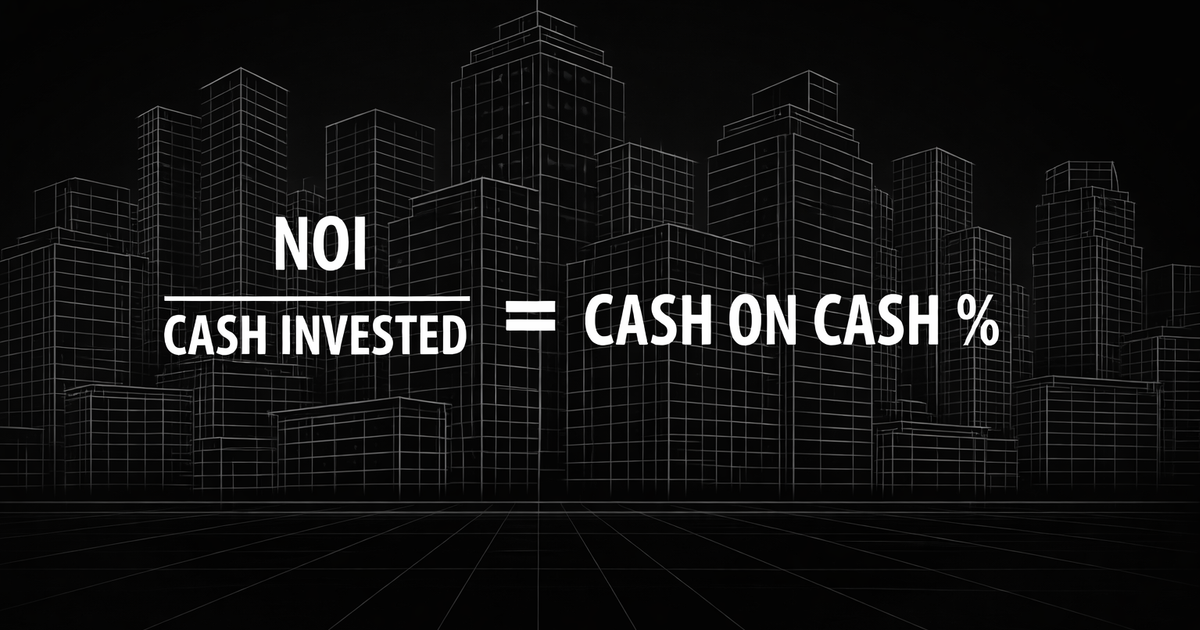
Cash-on-Cash Return = (Annual Pre-Tax Cash Flow / Total Cash Invested) x 100
Total cash invested means everything you spent before the property was rent-ready: down payment, closing costs (budget 2-3% of purchase price), rehab, inspections, any other out-of-pocket cost.
Most experienced investors won't touch a deal below 8% cash-on-cash for a conventional buy-and-hold. Below 6% and you're taking landlord risk for savings-account returns. The duplex example above sits at 5.1%: technically positive, practically marginal.
Total ROI: The full picture (use with caution)
Total First-Year ROI = (Annual Cash Flow + Annual Principal Paydown + Annual Appreciation) / Total Cash Invested x 100
This accounts for returns beyond cash flow, your tenants paying down your loan balance (roughly $2,000/year in year one on the duplex above) and, if you choose to include it, appreciation.
A word of caution on appreciation: it's speculative. Run your numbers without it first. If the deal only works because you're assuming 5% annual growth, it doesn't work. Appreciation is a bonus, not a business plan.
The $1,080/Year Most Investors Don't Know They're Losing
Here's where most rental property calculators fail you, not in the math, but in the timing.
Say Unit B is renting at $1,400, but comparable units within half a mile are leasing at $1,525. That's $125/month you're not collecting. Not because the unit is empty or the tenant is bad, because you haven't pulled comps since you signed the lease 14 months ago.
One unit. $125 below market. 1.7 percentage points of cash-on-cash return gone.
But the damage goes deeper than cash flow. That $125/month gap drags down your NOI by $1,500/year before vacancy and expense adjustments. And because property valuation is a function of NOI, value = NOI / cap rate, underpriced rent doesn't just cost you monthly income. At a 7% cap rate, that $1,500/year NOI gap means you're carrying a building worth roughly $21,000 less than it should be. Scale that across a 5-property portfolio and you're looking at $5,000-10,000/year in lost cash flow and six figures in suppressed equity. One of our Operator users discovered exactly this, three of five properties were $75-150/month below market. The portfolio-level NOI gap was costing them over $40,000 in building value they didn't know they'd lost.
This is the problem with one-time calculators. They give you a snapshot on the day you buy. But rents shift. Expenses change. That $278/month number is already wrong 6 months later if you aren't tracking comps.
Operator tracks median rents against your current lease rates across your entire portfolio, so you don't have to. When your rents drift below market, you see it in your dashboard before you set renewal terms, not after. $25/mo.
The 5 Inputs That Make or Break Your Numbers
Every rental property analysis comes down to five assumptions that investors consistently get wrong. Get these right and your projections will hold up in year three. Get them wrong and you'll be wondering why your "cash-flowing" property just needed an emergency $6,000 furnace replacement you didn't budget for.
Vacancy: use 8%, not 5%. The 5% default assumes 18 days of vacancy per year, one turnover with zero downtime for cleaning, repairs, or marketing. In practice, a single turnover costs 3-4 weeks of lost rent plus make-ready expenses. At 8%, you're budgeting about 29 days. If you have multiple units, some years run higher, some lower. 8% smooths it out without requiring optimism.
Insurance: get an actual quote. The "estimated insurance" on a listing is often the seller's homeowner's policy, not a landlord dwelling policy, which typically runs 15-25% higher. A property showing $1,400/year might actually cost $1,800-2,100/year to insure as a rental. Takes 10 minutes to get a real number. Doesn't take 10 minutes to realize your analysis was fiction.
CapEx: the line item investors skip. Maintenance covers faucets and locks. CapEx covers the roof ($8,000-15,000), HVAC ($4,000-8,000), water heater ($1,200-2,000), appliances ($2,000-4,000). Budget 5% of gross rent for maintenance and 5-10% for CapEx. Skip this line and your cash flow looks fantastic right up until the moment it disappears.
Management: include it, always. Self-managing saves 8-10% of gross rent, and that's real money. But if your rental property analysis only shows profit because you're working for free, you don't own an investment. You own a job. Include management at 10% in every analysis. If you choose to self-manage, treat the savings as bonus return, not baseline.
Market rent: pull your own comps. The rent the seller claims and the rent the market supports are two different conversations. Find 3-5 comparable rentals within 0.5 miles that match bedroom count and condition. Use the median: not the highest comp, not the asking price on a unit that's been sitting vacant for 45 days. If you can't find comps supporting the seller's number within 10%, your entire analysis is built on sand. For more on this, see our guide on rental comps.
Spreadsheet vs. One-Time Calculator vs. Operator
Three ways to run these numbers. Here's the honest trade-off.
Spreadsheets: like our rental property analysis spreadsheet or our deal analysis spreadsheet: work on the day you build them. The problem: your rent projection from 8 months ago doesn't know comparable units are now leasing for $150 more. Your expense estimates don't update when insurance premiums rise. And if you own more than 2-3 properties, maintaining separate spreadsheets for each one is a part-time job. Fine for a first pass. Not a portfolio management system.
One-time online calculators (BiggerPockets, DealCheck, etc.) give you a form, you fill it in, you get results. Better than a spreadsheet for a quick analysis because someone else built the formulas. Same fundamental problem: the output is frozen in time. You run numbers on evaluation day, and then the calculator doesn't know what happens next. Useful for initial screening. Not useful for managing an investment.
Operator runs this same analysis: cash flow, cash-on-cash, NOI, but against live market data, continuously, across every property in your portfolio. When rents move, your numbers update. When your lease rates drift below median market rent, you see the gap in your dashboard, not just the cash flow impact, but the NOI drag and what it's doing to your building's valuation. The difference isn't the math. The math is the same everywhere. The difference is whether you're making renewal decisions with today's data or last year's spreadsheet.
$25/mo for your entire portfolio. Try Operator →
Common Analysis Mistakes
Using the listing agent's rent estimate. The agent selling the property is not a neutral party. Pull your own rent comps.
Ignoring deferred maintenance. A property listed at $250K with a 15-year-old roof has $10,000-15,000 embedded in the purchase price that doesn't show up in any calculator. Inspect before you analyze.
Stress-testing at 5% vacancy. Run your numbers at 8% baseline, then stress-test at 10%. If the deal goes negative at 10%, it's thinner than you think. Markets soften. Evictions happen.
Comparing gross yield instead of cash-on-cash. Gross yield (annual rent / purchase price) ignores expenses, financing, and actual cash invested. Two properties with identical gross yield can have wildly different cash-on-cash returns. Gross yield is a screening metric. Cash-on-cash is an investment metric. Don't confuse them.
Running numbers once. A rental property analysis is not an event. Your cash flow changes every time rent shifts, expenses increase, or you refinance. If you haven't re-run your numbers in 12 months, you're making decisions on information that's already wrong.
FAQ
What numbers do I need to calculate rental property ROI?
Seven inputs at minimum: purchase price, down payment and closing costs, loan terms (rate, term, amount), expected gross monthly rent, vacancy rate (use 8%), itemized operating expenses (taxes, insurance, management, maintenance, CapEx), and any rehab costs. Missing any single input: especially CapEx reserves and realistic vacancy, will inflate your projected returns by 15-30%.
What is a good cash-on-cash return for a rental property?
8-12% for a conventional buy-and-hold. Below 6% and you're earning less than a high-yield savings account while taking on tenants, maintenance, and market risk. Above 15% typically involves value-add strategies like BRRRR or significant under-market rent with a clear path to increase. The "right" number also depends on your market; A-class suburban properties often run 4-7%, while B/C-class cash flow markets can deliver 10-15%. But most experienced investors I know won't write an offer under 8%.
How is rental property cash flow different from ROI?
Cash flow is dollars. ROI is a percentage. A property can show positive cash flow but deliver poor ROI if you invested a large amount of capital, $100/month on $150,000 invested is 0.8% annually. Cash flow keeps the property running. ROI tells you whether your capital should be somewhere else.
How does Operator calculate rental property returns differently than a spreadsheet?
It doesn't, the formulas are identical. The difference is that a spreadsheet calculates once using the numbers you type in. Operator keeps those same metrics current against live rent comps and market data. When comparable units in your zip code jump $150/month, your dashboard reflects it before your next renewal conversation. The math isn't the hard part. Keeping the inputs accurate across a portfolio is.
Should I include vacancy rate in my rental property calculation?
Always. A calculator that doesn't account for vacancy is showing you gross income, not realistic income. Budget 8% for a conservative analysis. Even in tight rental markets with sub-3% vacancy rates, you'll experience turnover gaps, make-ready time, and occasional slow months. Underestimating vacancy is the single most common reason new investors' actual returns fall short of projections.
Built for this
Operator runs every metric in this article automatically. Add a property, and you'll see cap rate, cash-on-cash, DSCR, and NOI in seconds — not hours. Your deal library saves every analysis so nothing gets lost.