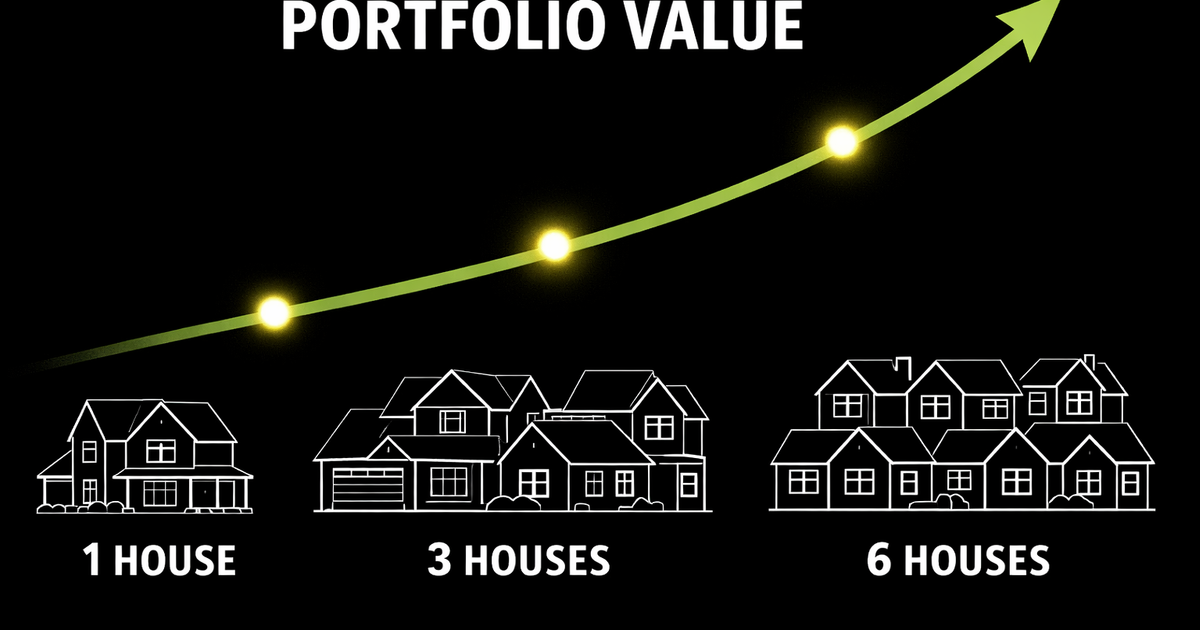
How to Build a Real Estate Portfolio
Building a real estate portfolio means acquiring multiple income-producing properties over time, using cash flow and equity from existing properties to fund additional purchases, starting with one property and scaling to 10, 20, or 50+ through disciplined reinvestment.
The Portfolio Mindset Shift
Your first rental property is a transaction. Your fifth is a portfolio.
The difference isn't just quantity. It's how you think:
Single-property thinking: "Does this house cash flow?"
Portfolio thinking: "How does this property affect my total NOI, my debt coverage, my geographic diversification, and my ability to acquire the next one?"
Run the numbers on every deal with a rental property calculator before making an offer. A property that looks weak in isolation might be strong in context; a 6% cap rate in an appreciating market balances your 10% cap rate cash flow plays. A property with modest cash flow but rapid principal paydown accelerates your next down payment.
Portfolio building is a system, not a series of one-off deals.
Phase 1: The First Three Properties (Years 1-3)
Most investors can acquire 1-3 properties using conventional financing and savings.
Property 1: Learn the process
Your first deal is education. You'll learn the buying process, tenant screening, lease creation, and maintenance coordination. Even experienced investors make mistakes on property #1. Keep it simple: a single-family or small multifamily in your local market where you can self-manage.
Target: Positive cash flow of any amount. Breaking even is acceptable. Losing money monthly is not.
Property 2: Refine the system
Apply lessons from property #1. Tighten your screening criteria if you had tenant issues. Adjust your expense projections if reality differed from your spreadsheet. Many investors buy property #2 within 12-18 months of #1.
Property 3: Optimize for scale
By property #3, you should have standard operating procedures: a lease template, a maintenance contractor list, a bookkeeping system, and a screening process. This is where most investors decide whether to keep self-managing or hire property management.
Financing at this stage:
- Conventional loans (15-25% down) for properties 1-4
- FHA/house hacking for property #1 if you'll live in it (3.5% down)
- Home equity from your primary residence as down payment source
Phase 2: Scaling From 4 to 10 Properties (Years 3-7)
This is where conventional financing gets harder and portfolio strategy matters more.
The Fannie/Freddie wall: Conventional lenders typically cap you at 10 financed properties. After 4 properties, underwriting scrutinizes your rental income more heavily. After 10, you're limited to portfolio lenders, DSCR loans, or commercial financing.
Financing strategies at this stage:
- DSCR loans: Qualify based on property cash flow, not personal income. Higher rates (7-9%) but no limit on number of properties.
- Portfolio lenders: Local banks that keep loans on their books. More flexible underwriting, relationship-based.
- Commercial loans: For 5+ unit properties. 20-25% down, shorter amortization, but no property count limits.
- Seller financing: Negotiate directly with sellers. 10-20% down, 5-7 year balloon typical.
Cash flow reinvestment: At 4-10 properties generating $300-500/month each, you're collecting $1,200-5,000/month in portfolio cash flow. Reinvest 100% into reserves and down payment savings. Every 18-24 months, you should have another down payment accumulated.
The 1031 exchange option: Sell a property, defer capital gains taxes, and roll proceeds into a larger property. A $200,000 duplex becomes a $400,000 fourplex becomes an $800,000 8-unit. Portfolio growth without new capital injection.
Phase 3: Portfolio Optimization (10+ Properties)
At 10+ properties, management and tracking become as important as acquisition.
What changes:
- Spreadsheets break down. Tracking 10+ properties with income, expenses, leases, maintenance, and debt in spreadsheets becomes a part-time job. You need portfolio management software.
- Underperformers hide. Your $200/month cash flow property might actually be $50/month when you account for deferred maintenance and below-market rent. You won't know unless you're tracking against benchmarks.
- Opportunity cost matters. Capital tied up in a 5% cap rate property could be earning 8% elsewhere. But you only know this if you're measuring.
This is where Operator becomes essential. Track portfolio NOI, compare rent to market comps, set alerts for underperformers, and generate lender-ready reports, all in one place. $25/month is irrelevant at 10+ properties generating $5,000+ monthly cash flow.
Portfolio Allocation Strategy
Not every property should be the same. Balance:
Cash flow properties (8-12% cap rate): Midwest and Southeast markets. Lower appreciation, higher monthly income. These pay your bills.
Appreciation properties (4-7% cap rate): Coastal and growth markets. Lower cash flow, higher long-term equity gains. These build wealth.
A common allocation:
Start heavy on cash flow to build momentum. Add appreciation plays as your portfolio matures.
The Numbers: From 0 to 10 Properties
Here's a realistic 7-year trajectory for an investor starting with $50,000 savings:
Assumptions: $200,000 average property, $150,000 average loan, $300/month average cash flow, 3% annual appreciation, reinvesting all cash flow.
After 7 years: $700,000 equity, $4,500/month cash flow, 10 properties. All from a $50,000 start.
What Kills Portfolio Growth
Living on cash flow too early. Treat cash flow as untouchable until you hit 10 properties. Every dollar withdrawn is a dollar not compounding into your next down payment.
Ignoring property performance. A property you bought at 8% cap that's now operating at 5% cap is dead weight. If you're not tracking, you won't know. I've seen investors hold properties for years that should have been sold or repositioned.
Over-leveraging. 80% LTV across your portfolio leaves no margin for vacancy or rate increases. Target 65-70% blended LTV once you're past 5 properties.
Analysis paralysis. The investor who buys one property every 3 years will never build a portfolio. Set acquisition targets: 1-2 properties per year, and execute.
FAQ
How many properties do you need for a real estate portfolio?
A real estate portfolio typically starts at 3-5 properties, where you begin to see diversification benefits and cash flow compounds meaningfully. At 10+ properties, portfolio management and optimization become as important as acquisition. Most full-time real estate investors target 15-30 properties for financial independence.
How long does it take to build a real estate portfolio?
Building a 10-property portfolio typically takes 5-8 years starting from zero, assuming consistent reinvestment of cash flow and equity. Investors using aggressive strategies like BRRRR or house hacking can accelerate to 10 properties in 3-5 years. Pace depends on starting capital, market conditions, and how much cash flow you reinvest vs. withdraw.
How do you finance a real estate portfolio?
Properties 1-4 use conventional financing (15-25% down). Properties 5-10 may require portfolio lenders, DSCR loans, or creative financing as conventional limits tighten. Beyond 10 properties, most investors use DSCR loans (qualify on property cash flow, not personal income), commercial loans, or seller financing. Each strategy has trade-offs in rate, terms, and qualification requirements.
Built for this
Operator runs every metric in this article automatically. Add a property, and you'll see cap rate, cash-on-cash, DSCR, and NOI in seconds — not hours. Your deal library saves every analysis so nothing gets lost.