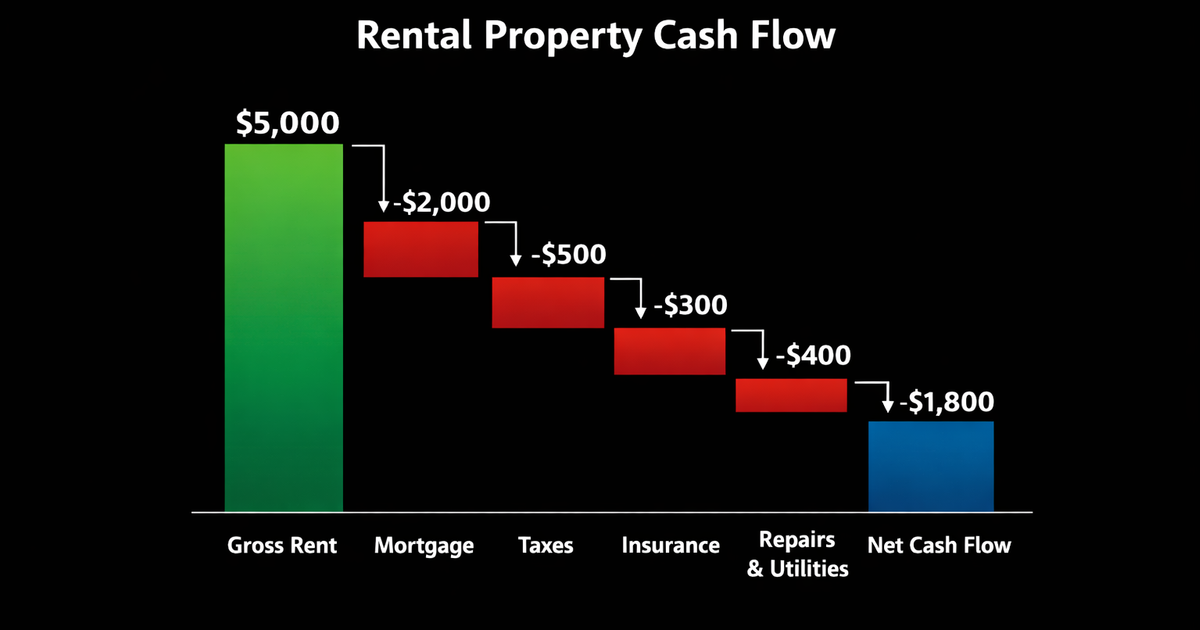
Rental Property Cash Flow Analysis: How to Run the Numbers
A rental property cash flow analysis calculates the monthly profit (or loss) after subtracting all operating expenses, reserves, and debt service from rental income, the number that determines whether a property pays you or drains you.
The Cash Flow Formula
Monthly Cash Flow = Gross Rent − Vacancy − Operating Expenses − Debt Service
Or broken down further:
Cash Flow = Rent − Vacancy − Taxes − Insurance − Management − Repairs − CapEx − Utilities − HOA − Mortgage
Every expense matters. Leave one out and your "cash flowing" property becomes a money pit.
Cash Flow Analysis: Line by Line
1. Gross Rental Income
What the tenant pays monthly. Use actual lease amount for occupied properties. For vacancies or purchases, use comparable market rents (see our rental CMA guide).
Do not use: Zillow Zestimate rent, optimistic projections, or what the seller claims.
2. Vacancy Allowance
No property runs 100% occupied forever. Tenants move. Turnovers take 2-4 weeks. Account for this.
Calculation: $1,800 rent × 5% vacancy = $90/month effective loss
Your effective gross income is $1,800 − $90 = $1,710.
3. Property Taxes
Annual property tax ÷ 12. Pull the actual amount from county assessor records, not estimates.
Warning: Taxes reassess after purchase in many states. That $2,400/year tax bill might become $4,200/year once the county catches up to your purchase price. Model post-purchase taxes, not current owner's amount.
4. Insurance
Annual landlord policy premium ÷ 12. Get an actual quote: don't guess. Insurance varies wildly:
- $80-120/month typical for most SFRs
- $150-300/month in Florida, Louisiana (hurricane zones)
- $200-400/month if you have claims history
5. Property Management
If you hire a manager: 8-10% of collected rent plus leasing fees (typically 50-100% of first month's rent, amortized).
If you self-manage: still include this line. Your time has value. When you calculate cash flow at $0 management and later realize you spend 5 hours/month on the property, that "cash flowing" deal looks different.
I include 8% even for properties I self-manage. If I ever stop managing, the true cash flow is already modeled.
6. Repairs and Maintenance
Things break. Budget 1% of property value annually for ongoing repairs.
$200,000 property × 1% = $2,000/year = $167/month
Newer properties (built after 2000): 0.5-0.75% may be adequate. Older properties (pre-1980): 1.5-2% is safer.
7. Capital Expenditure (CapEx) Reserves
Major replacements: roof, HVAC, water heater, appliances, flooring. These aren't annual expenses but they're inevitable. Reserve monthly so you're not surprised.
Budget 1% of property value annually, or itemize:
8. Utilities (If Landlord-Paid)
Water, sewer, trash, lawn care: if you pay them, include them.
Tenant-paid utilities: $0 in your analysis (but confirm what's included in lease).
9. HOA Fees
Monthly dues if applicable. Don't forget special assessments; HOAs can levy $5,000+ charges for major repairs.
10. Debt Service (Mortgage Payment)
Principal + interest on your loan. Use actual terms, not estimates.
Mistake I see constantly: Using a mortgage calculator at 6.5% when actual rates are 7.5%. That 1% difference is $100+/month on a $150,000 loan.
Complete Cash Flow Example
Property: 3-bed SFR, $225,000 purchase, $1,950/month rent
This property is cash flow negative at current rates with full expense loading. It loses $240/month, $2,880/year.
Is it a bad investment? Not necessarily. You're building equity ($350/month in principal paydown), potential appreciation, and tax benefits. But it's not a cash flow play.
What Good Cash Flow Looks Like
I target $200/month minimum per property. Below that, the juice isn't worth the squeeze.
The Spreadsheet You Need
Every property analysis should include:
- Income section: Rent, vacancy, other income
- Operating expense section: All expenses above
- NOI calculation: Income minus operating expenses
- Debt service section: Mortgage payment
- Cash flow calculation: NOI minus debt service
- Return metrics: Cash-on-cash, cap rate, DSCR
Download our rental property analysis spreadsheet, use our rental property calculator to run numbers quickly, or track expenses using a rental property expenses spreadsheet.
Projections vs. Reality
Every analysis is a projection. After you buy, track actuals.
My first property projected $280/month cash flow. Year one reality: $85/month. Vacancy hit 8% (not 5%), repairs ran $2,400 (not $1,800), and I underestimated insurance by $40/month.
Now I track every property in Operator. Actual income, actual expenses, actual cash flow. After 12 months, I know exactly how projections compared to reality, and I adjust future analyses accordingly.
FAQ
How do you calculate rental property cash flow?
Cash flow = Gross Rent − Vacancy − Operating Expenses − Mortgage Payment. Operating expenses include property taxes, insurance, property management (8-10%), repairs (1% of property value), CapEx reserves (1%), and any landlord-paid utilities. Subtract your mortgage principal and interest payment from net operating income to get monthly cash flow.
What is a good cash flow for a rental property?
Good cash flow is $200-300 per month after all expenses and reserves. Below $100/month leaves no margin for unexpected costs. $300-500/month provides strong buffer against vacancy and repairs. Above $500/month is excellent but typically requires high rent-to-price ratios found in cash flow markets like Memphis or Cleveland.
Should I include property management in cash flow analysis?
Yes, include 8-10% for property management even if you self-manage. Your time has value, and excluding management inflates apparent cash flow. If you later hire a manager or sell to an investor who will, the true cash flow is already modeled. Professional analysis always includes management costs.
Built for this
Operator runs every metric in this article automatically. Add a property, and you'll see cap rate, cash-on-cash, DSCR, and NOI in seconds — not hours. Your deal library saves every analysis so nothing gets lost.