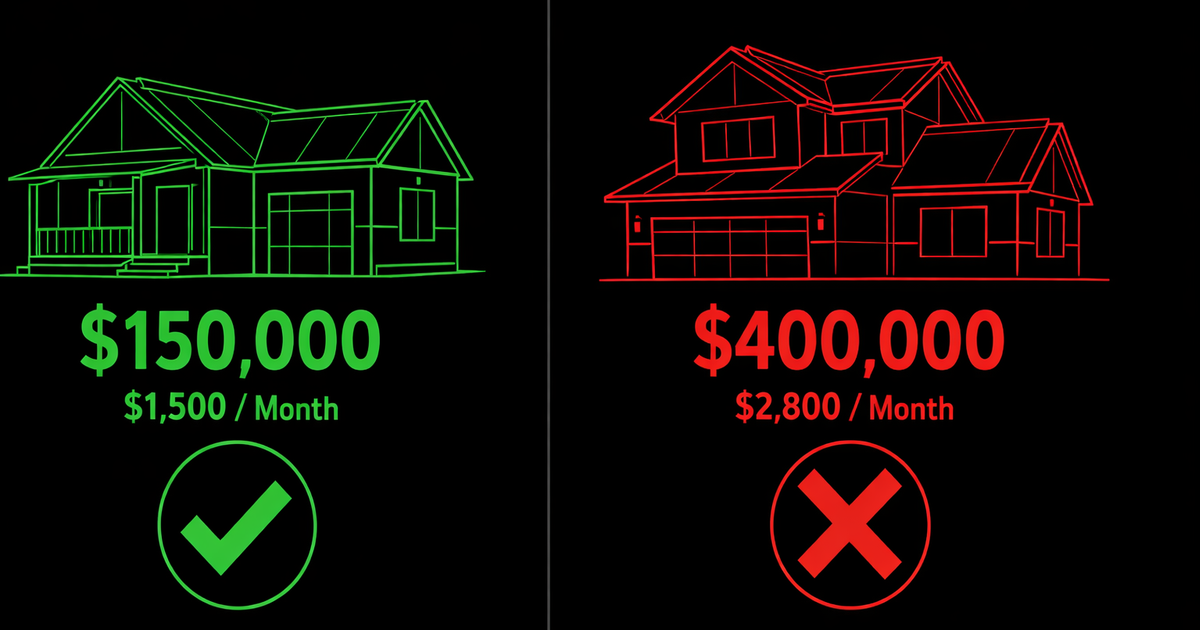
Two Properties. One Passes the 1% Rule. The Other Doesn't. Guess Which One Loses Money.
The 1% rule states that a rental property's monthly rent should equal at least 1% of its purchase price, so a $150,000 property should rent for $1,500/month or more to likely generate positive cash flow. It's a 10-second screening filter, not an analysis method. And at 2026 interest rates, it can actively mislead you.
Here's why.
The Comparison Nobody Shows You
Property A: Memphis, 1978 build, $130,000 purchase price Rents for $1,350/month. Rent-to-price ratio: 1.04%. Passes the 1% rule.
Property B: Indianapolis, 2005 build, $180,000 purchase price Rents for $1,550/month. Rent-to-price ratio: 0.86%. Fails the 1% rule. (For more on SFR investing, see our dedicated guide.)
If you're using the 1% rule as your primary filter, you buy Property A and pass on Property B. Let's see how that decision plays out over five years.
Property A, the one that "passed", lost more money over five years than Property B. The 1% rule said nothing about the 1978 roof that needed replacing in year two, or the HVAC that died in year four. It also said nothing about Property B's newer construction, lower insurance premiums, and tenants who stayed three years instead of 14 months.
The rule screened for the wrong variable.
What the 1% Rule Actually Is
Monthly Rent / Purchase Price = Rent-to-Price Ratio
$200,000 property, $2,000 rent = 1.0%. Pass. $320,000 property, $2,100 rent = 0.66%. Fail.
The rule exists because investors needed a way to eliminate 90% of listings without opening a spreadsheet. If a property can't hit 1%, the odds of positive cash flow were historically low enough to skip it. The word "historically" is doing heavy lifting in that sentence, because the rule was created when mortgage rates were 4-5%.
At 4.5%, a 1% property cash flows $376/month self-managed. At 7.25%, the same property cash flows $69/month. Same property. Same rent. Same expenses. The only thing that changed was the rate, and it turned a strong deal into a marginal one.
The Math Across the Spectrum
Here's what cash flow and returns look like at different rent-to-price ratios, assuming $200,000 purchase, 25% down, 7.25% rate:
At current rates, you need roughly 1.1% for an 8%+ cash-on-cash return self-managed. You need 1.2% to cash flow meaningfully with a property manager. The 1% rule still works as a floor: below 1% is almost certainly negative with management, but passing 1% is no longer the green light it was in 2019.
Where 1% Properties Still Exist
High rent-to-price markets. Generally Midwest and Southeast metros where values stayed low relative to rents:
Detroit looks incredible on paper. 1.4% rent-to-price. But Detroit also has the highest eviction rates, longest vacancy periods, and most expensive property insurance in this list. The 1% rule doesn't adjust for any of that.
Where It's Dead
Appreciation markets: coastal cities and hot Sun Belt metros where values outpaced rents years ago:
San Francisco ($1.2M median, $4,500 rent, 0.38%), Los Angeles ($800K, $3,200, 0.40%), Austin ($450K, $2,200, 0.49%), Denver ($500K, $2,400, 0.48%), Seattle ($700K, $3,000, 0.43%), Miami ($550K, $2,800, 0.51%).
Nobody in these markets is buying for cash flow. They're betting on appreciation, tax benefits, and long-term equity growth. Different strategy, different math, different risk. If you're evaluating a San Francisco property with the 1% rule, you're using a tape measure to check the weather.
The Four Things the 1% Rule Can't See
Property taxes vary 5x across markets
A 1% property in Houston (2.5% property tax rate) performs dramatically worse than a 0.9% property in Phoenix (0.6% tax rate). The math: $150,000 property in Houston costs $313/month in taxes. Same property in Phoenix: $75/month. That $238/month difference wipes out the entire cash flow advantage of meeting the 1% rule. The Phoenix property at 0.9% might actually cash flow better.
Insurance costs vary 3-5x
Florida and Louisiana carry premiums 3-5x the national average. A 1% property with $4,000/year insurance is fundamentally different from one with $1,200/year, but the rule treats them identically.
Building age isn't a number in the formula
The comparison at the top of this article tells the whole story. A 1978 property with original systems has $10,000-20,000 in CapEx embedded in its future. A 2005 property has another 15+ years before major replacements hit. The 1% rule doesn't see building age, CapEx risk, or deferred maintenance. It sees rent divided by price and nothing else.
Rent growth changes the entire trajectory
A 0.8% property in a market with 5% annual rent growth overtakes a 1.1% property in a flat market within 3 years.
Starting at $1,600/month (0.8%) with 5% annual growth: Year 1 rent is $1,600. Year 3: $1,764. Year 5: $1,944. Meanwhile the 1.1% property in a flat market stays at $2,200/month forever. Same cash flow eventually, but the 0.8% property is also appreciating, and the 1.1% property isn't. One investor built wealth. The other collected slightly more rent and went nowhere.
Operator monitors your rents against live market comps, so you know whether you're at 0.8% and rising or 1.1% and flat. When your rents drift below market, you see the cash flow and valuation impact before renewal time. $25/mo.
What to Use Instead
The 1% rule is a filter. Use it as one. After a property passes the initial screen, run three real calculations:
Full cash flow analysis. Input actual taxes, insurance, and expense estimates. Model vacancy at 5-8%, repairs at 1% of property value, CapEx at 1%, and include property management even if you self-manage. Use a rental property calculator, not a rule of thumb. Our guide on how to analyze a rental property walks through every line item.
Cash-on-cash return. Annual cash flow divided by total cash invested. Target 8%+ for buy-and-hold. A property can meet the 1% rule and still deliver poor cash-on-cash if your down payment and closing costs are high relative to annual cash flow.
DSCR. Net operating income divided by annual debt service. Below 1.25, most lenders won't approve the loan, and more importantly, you don't have enough income cushion to survive a bad quarter. A deal that hits 1% rent-to-price but shows 1.05 DSCR is a marginal deal in a good costume.
Operator calculates cash flow, CoC, and DSCR from live market data. Skip the 1% rule and run real analysis on any property address. $25/mo.
The Rule at Different Interest Rates
Same property ($150K, $1,500/mo rent) across rate environments:
Same property, same rent, same expenses. The only variable is the rate. At 4%, this is a strong deal. At 7.25%, it barely breathes. The 1% rule doesn't account for rate environment, and in 2026, that's the variable that matters most.
FAQ
What is the 1% rule in real estate?
Monthly rent should be at least 1% of purchase price. A $200,000 property should rent for $2,000/month. It's a screening filter: properties below 1% are unlikely to cash flow at current rates. But passing 1% doesn't guarantee profitability, especially after accounting for taxes, insurance, CapEx, and management.
Is the 1% rule realistic in 2026?
In Midwest and Southeast markets: Memphis, Cleveland, Indianapolis, Birmingham, yes, 1% properties exist. In coastal cities and expensive Sun Belt metros, no. At 7%+ rates, many investors now target 1.1-1.2% as the real threshold for meaningful cash flow with professional management. The original 1% threshold was calibrated for 4-5% rates.
Should I only buy properties that meet the 1% rule?
No. Properties below 1% can be strong investments if they offer appreciation potential, low property taxes, newer construction with minimal CapEx risk, or value-add opportunity. A 0.85% property in Phoenix with 0.6% property tax and a 2010 build can outperform a 1.1% property in Memphis with 2.5% tax and a 1975 build over a 10-year hold. Always run full analysis; the 1% rule is a starting filter, not a decision.
What is the 2% rule in real estate?
Monthly rent at 2% of purchase price, so a $100,000 property renting for $2,000. Extremely rare in 2026. Properties that hit 2% typically sit in high-crime, high-vacancy neighborhoods where the elevated turnover, delinquency, and management costs offset the paper returns. Most investors who chase 2% deals learn this the expensive way.
How does Operator help beyond the 1% rule?
Operator runs the real analysis: cash flow, cash-on-cash return, DSCR, and cap rate from live rent comps, not estimates, not rules of thumb. It also monitors your portfolio over time, so when rents shift, you see the impact on your returns before you set renewal terms. $25/month.
Built for this
Operator runs every metric in this article automatically. Add a property, and you'll see cap rate, cash-on-cash, DSCR, and NOI in seconds — not hours. Your deal library saves every analysis so nothing gets lost.