Equity Multiple Formula: How to Calculate and Interpret It
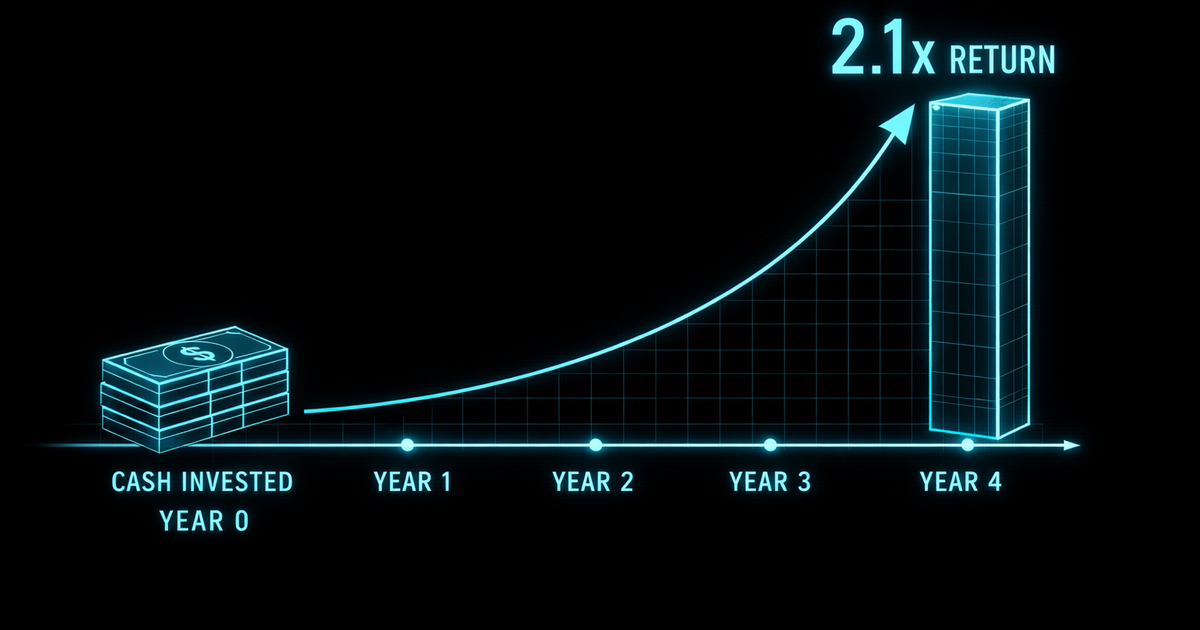
Equity multiple is the total cash returned from an investment divided by the total equity invested; a 2.0x equity multiple means you received $2 back for every $1 you put in, doubling your money over the investment period.
The Equity Multiple Formula
Equity Multiple = Total Distributions ÷ Total Equity Invested
Total distributions include everything you received: operating cash flow during the hold period, plus proceeds from sale or refinance. Total equity invested is your out-of-pocket capital: down payment, closing costs, rehab, and any additional capital calls.
An equity multiple below 1.0x means you lost money. Exactly 1.0x means you got your capital back with zero profit. Anything above 1.0x is profit.
Worked Example 1: Syndication Investment
You invest $100,000 in a multifamily syndication with a 5-year projected hold.
Total distributions: $8,000 + $8,000 + $8,500 + $9,000 + $9,500 + $180,000 = $223,000
Equity multiple: $223,000 ÷ $100,000 = 2.23x
You more than doubled your money in 5 years. The annualized IRR on this deal is approximately 17.4%.
Worked Example 2: Buy-and-Hold Rental Property
You buy a $240,000 single-family rental. Here are your actual numbers over 7 years.
Cash invested at purchase:
Annual cash flow (net of all expenses, mortgage, vacancy, and CapEx (see our cash flow analysis guide):
Sale in Year 7:
- Sale price: $295,000 (3% annual appreciation)
- Selling costs (6%): -$17,700
- Remaining mortgage balance: -$170,400
- Net sale proceeds: $106,900
Total distributions: $31,500 + $106,900 = $138,400
Equity multiple: $138,400 ÷ $73,000 = 1.90x
You nearly doubled your money: 90% total return over 7 years, or roughly 9.6% annualized. Compare that to the annual cash-on-cash return, which only measures operating cash flow relative to invested capital.
Worked Example 3: Value-Add Duplex (BRRRR)
Buy a distressed duplex for $180,000, invest $45,000 in rehab, refinance at new appraised value, and hold.
After rehab, the property appraises at $280,000. You refinance at 75% LTV = $210,000 loan.
- Pay off original mortgage ($135,000): -$135,000
- Cash back from refi: $210,000 - $135,000 = $75,000
Net equity still in the deal: $95,400 - $75,000 = $20,400
Now the duplex generates $6,000/year net cash flow and you hold for 5 years:
- Total cash flow: $6,000 × 5 = $30,000
- Net sale proceeds in Year 5 (after mortgage payoff, selling costs): $52,000
Total distributions: $75,000 (refi) + $30,000 (cash flow) + $52,000 (sale) = $157,000
Equity multiple: $157,000 ÷ $95,400 = 1.65x
But here's the key: you only have $20,400 of your own money still at risk after the refi. On that remaining capital, the cash flow and sale returns represent a much higher effective return. This is why BRRRR investors love the strategy: you recycle capital while equity multiples compound across deals.
Operator tracks equity multiple across every property in your portfolio: purchase price, total invested, cumulative distributions, and current estimated value. You see which properties are actually multiplying your capital and which ones are dragging. $25/mo.
What's a Good Equity Multiple?
Benchmarks depend on hold period, risk level, and asset type.
A 2.0x multiple sounds the same whether it takes 3 years or 10. It isn't. A 2.0x in 3 years is ~26% annualized. A 2.0x in 10 years is ~7.2% annualized. Always pair equity multiple with hold period.
Equity Multiple vs. IRR
Both metrics matter. They answer different questions.
Equity multiple tells you total profit: how many times you multiplied your capital.
IRR tells you annualized return: how fast you earned that profit.
Why you need both: IRR can be gamed by timing. A sponsor who returns capital quickly (via refi) inflates IRR even if total returns are modest. A deal returning 1.3x in 18 months shows ~18% IRR, an impressive annualized rate, but you only made 30% total profit on your capital. Meanwhile a boring 2.5x over 7 years shows ~14% IRR but leaves you with 150% profit.
Equity multiple is manipulation-resistant. It only asks: did you get your money back, and how much more?
Target both: For value-add syndications, look for 1.8x+ equity multiple AND 15%+ IRR. If a deal promises 2.5x over 10 years, that's only ~9.6% IRR; you can approach that in index funds without the illiquidity.
Common Equity Multiple Mistakes
1. Ignoring time value of money
A 2.0x in 3 years and 2.0x in 10 years are radically different investments. Always calculate or request the IRR alongside equity multiple. If a sponsor only shows equity multiple and won't provide IRR projections, that's a red flag.
2. Forgetting additional capital contributions
Equity invested includes everything: down payment, closing costs, rehab capital, and any capital calls during the hold. If you invested $100,000 initially and $25,000 more in Year 3 for a capital call, your total equity invested is $125,000, not $100,000. Using the wrong denominator inflates your multiple.
3. Confusing gross and net distributions
Equity multiple should use net distributions: after sponsor fees, promote/waterfall splits, disposition fees, and taxes. A sponsor projecting 2.5x gross might deliver 2.0x net after a 20% promote above an 8% preferred return. Ask which version you're seeing.
4. Not accounting for return OF capital vs. return ON capital
In syndications, early distributions often include return of capital (your own money coming back to you). A $10,000 distribution isn't profit if $6,000 of it is capital return. This doesn't change the equity multiple math, but it changes your tax picture; return of capital is tax-deferred until your basis hits zero.
Tracking equity multiple by hand across 5, 10, or 20 properties means reconciling capital invested, cumulative cash flow, and estimated current value for each one. Operator calculates it automatically from your portfolio data and shows you a single dashboard view. $25/mo.
How to Increase Equity Multiple on Rental Properties
Three levers move the needle:
1. Force appreciation through rent increases. If your property's NOI drives its value (cap rate × NOI), pushing rents to market rate directly increases your sale proceeds. A $200/month rent increase on a duplex = $4,800 additional NOI. At a 7% cap rate, that adds $68,571 to property value, and to your equity multiple numerator.
2. Reduce basis through refinancing. The BRRRR strategy pulls cash out via refi, reducing your net equity in the deal. Same total distributions on a smaller denominator = higher equity multiple on capital still at risk.
3. Hold long enough to benefit from principal paydown. Every mortgage payment shifts wealth from lender to you. On a $200,000 loan at 7%, you build roughly $2,000 in equity during Year 1 and $4,200 by Year 7. Over a 10-year hold, principal paydown alone adds 15-20% to your total distributions at sale.
Operator monitors your rents against live market comps. When your rents fall below market, you're suppressing NOI, and your building's value along with it. Operator shows you exactly where that gap is so you can close it at your next renewal. $25/mo.
FAQ
What is a good equity multiple in real estate?
For value-add multifamily syndications with 3-5 year holds, target 1.8-2.2x equity multiple. For individual rental properties held 7-10 years, 2.0-3.0x is reasonable with leverage and moderate appreciation. Below 1.5x is weak for any active real estate strategy; above 2.5x on a short hold warrants scrutiny of the underlying assumptions.
How do you calculate equity multiple?
Equity multiple = Total Distributions ÷ Total Equity Invested. Total distributions include all operating cash flow during the hold period plus sale or refinance proceeds. Total equity invested is your out-of-pocket capital including down payment, closing costs, rehab, and any additional capital calls. A $100,000 investment returning $220,000 total has a 2.2x equity multiple.
What is the difference between equity multiple and IRR?
Equity multiple measures total profit: how many times you multiplied your invested capital. IRR measures annualized return: how fast you earned that profit. A 2.0x equity multiple over 3 years equals roughly 26% IRR; the same 2.0x over 7 years equals roughly 10% IRR. Use both: equity multiple to assess total return, IRR to assess time efficiency. IRR can be inflated by early capital returns, while equity multiple is manipulation-resistant.
Does equity multiple include return of capital?
Yes. Equity multiple counts all distributions, including return of your original capital. A 2.0x multiple means you received $2 for every $1 invested: $1 is return of capital and $1 is profit. This is by design: the formula measures total cash back relative to cash in, giving you a simple measure of whether an investment grew your wealth.
How does Operator help track equity multiple?
Operator calculates equity multiple across your entire rental portfolio by tracking purchase price, total capital invested, cumulative cash flow received, and current estimated property value. Instead of reconciling spreadsheets across multiple properties, you see a single dashboard showing which properties are multiplying capital and which are underperforming, updated with live market data. $25/month for unlimited properties.
Built for this
Operator runs every metric in this article automatically. Add a property, and you'll see cap rate, cash-on-cash, DSCR, and NOI in seconds — not hours. Your deal library saves every analysis so nothing gets lost.