Yes, you can use ChatGPT, Claude or Gemini to analyze a rental property, and they handle the first pass well: the cash-flow math, cap rate, DSCR and a quick go or no-go. But they can invent rent comps, use an out-of-date mortgage rate and leave out expenses like management, CapEx reserves and post-sale property taxes, so you have to supply or check those numbers yourself.
Key takeaways
- A general AI assistant is a fast way to run the math on a rental deal, as long as you give it the inputs instead of letting it guess them.
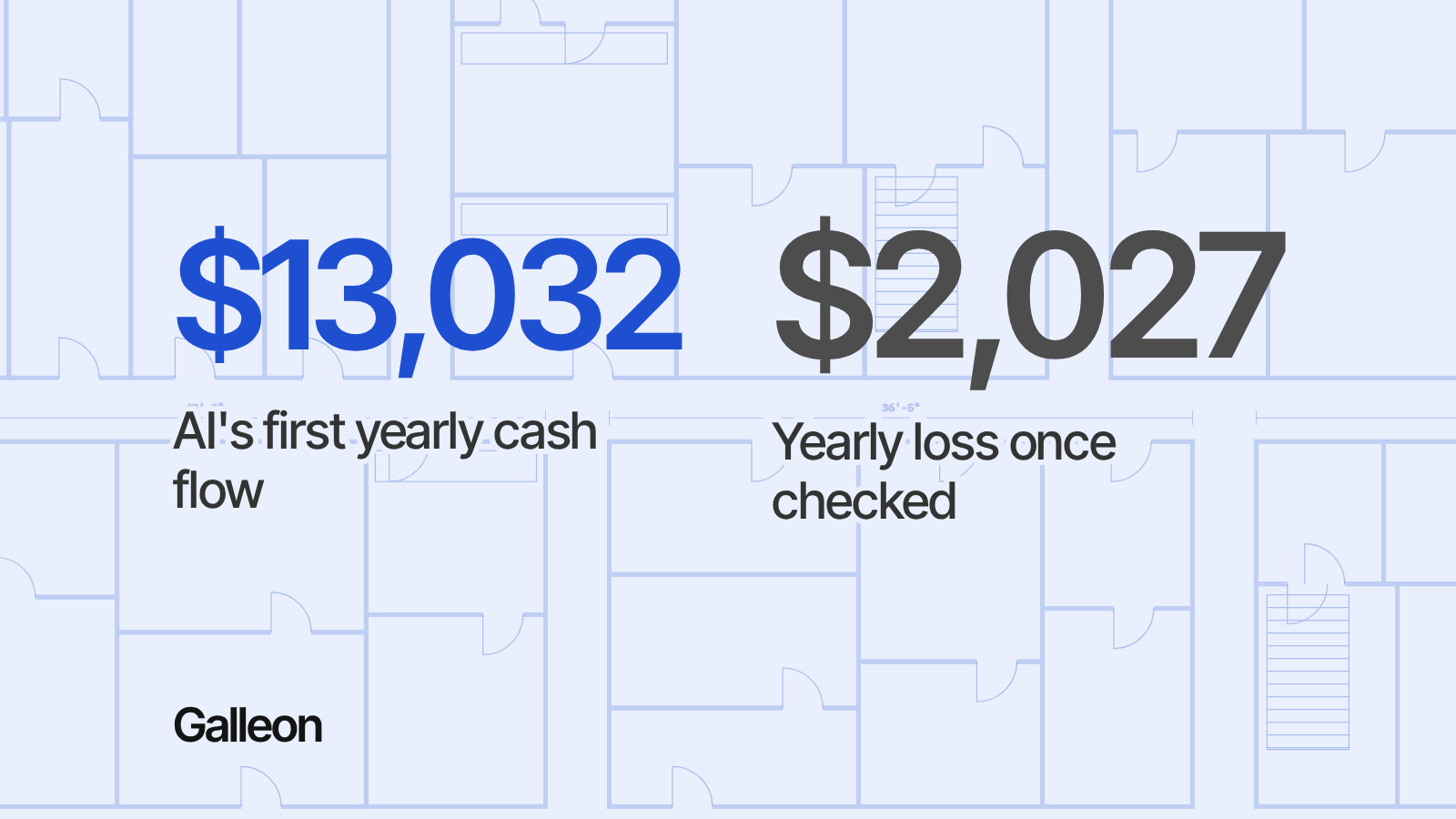
- In our duplex example, a loose prompt produced a BUY with $13,032 a year of cash flow, and the checked numbers showed a $2,027 yearly loss.
- Leaving out management, using a stale mortgage rate and skipping a CapEx reserve were the three costliest mistakes, worth $3,420, $2,953 and $2,565 a year.
- Freddie Mac's weekly average rate describes owner-occupants with 20% down, so it isn't an investor rate, and you need a real lender quote.
- When a deal fails, ask the AI for the highest price that works; in our example that's about $216,000 against a $300,000 asking price.
- Redact tenant names and account numbers before you upload leases or bank statements.
What AI does well on a rental deal, and where it slips
A general AI assistant is a strong calculator that knows the formulas. Give it a price, rents, expenses and loan terms, and it'll lay out NOI, cap rate, DSCR and cash-on-cash quickly. The trouble starts when you leave a blank, because it fills the blank with a guess and doesn't always tell you it did.
| Usually reliable | Check every time |
|---|---|
| Arithmetic for NOI, cap rate, DSCR and cash-on-cash | Rent comps, which it may cite loosely or invent |
| A clean pro forma table | The mortgage rate, which changes weekly |
| Sensitivity tests on rate and rent | Expenses that seller numbers leave out |
| Solving for a maximum price | Property taxes after the sale |
Mortgage rates are a good example. Freddie Mac publishes its mortgage rate survey every Thursday at noon Eastern, so any rate a model learned in training goes stale fast. If your assistant searches the web, the risk is different: it can pull an old or secondhand page and quote it with full confidence.
One duplex, run through the AI twice
Our example is a $300,000 duplex bought with 25% down ($75,000), a $225,000 30-year loan and 3% closing costs ($9,000), so $84,000 of cash goes in. It's a made-up deal for illustration, not a listing.
For the first run, we used the kind of prompt a busy investor types: the price, the listed rent of $1,600 a unit, the seller's tax bill of $3,900, and "is this a good deal?" The assistant filled in the rest on its own. It guessed $1,100 for insurance, used 5% for repairs, left out management, CapEx reserves and owner-paid utilities, and picked a 6.25% rate. Its verdict was BUY.
The second run used inputs we supplied ourselves. Rent dropped to $1,500 a unit, the median of the example's rental comps, and the listed $1,600 sits 6.7% above that median.
Repairs, CapEx reserve and management use the defaults from Real Estate Operator's free Multifamily Underwriting skill: 7.5%, 7.5% and 10% of collected rent, plus 5% vacancy. The skill also flags any broker rent more than 5% above the comp median, which our $1,600 listing rent would trip.
The last four inputs are labeled assumptions you'd replace with real quotes: $4,800 of property tax after a reassessment on the $300,000 price, $2,100 for a landlord insurance policy, $1,200 a year of owner-paid water, sewer and trash, and a 7.875% rate.
| Line | AI's first answer | Checked answer |
|---|---|---|
| Rent per unit | $1,600 (listing) | $1,500 (comp median) |
| Gross potential rent | $38,400 | $36,000 |
| Vacancy (5%) | -$1,920 | -$1,800 |
| Collected rent | $36,480 | $34,200 |
| Property tax | $3,900 (seller's bill) | $4,800 (reassessed) |
| Insurance | $1,100 (AI guess) | $2,100 |
| Water, sewer, trash | $0 | $1,200 |
| Repairs | $1,824 (5%) | $2,565 (7.5%) |
| CapEx reserve | $0 | $2,565 (7.5%) |
| Management | $0 | $3,420 (10%) |
| NOI | $29,656 | $17,550 |
| Cap rate | 9.9% | 5.85% |
| Rate | 6.25% | 7.875% |
| Monthly payment | $1,385 | $1,631 |
| Annual debt service | $16,624 | $19,577 |
| DSCR | 1.78 | 0.90 |
| Yearly cash flow | $13,032 | $2,027 loss |
| Cash-on-cash | 15.5% | -2.4% |
Galleon example, not a quote.
Watch out: At the checked numbers, break-even occupancy is about 101%, so this duplex loses money even with both units rented every month of the year.
What each mistake cost
To see which errors matter most, we started from the checked version and swapped back one AI input at a time. Each row shows how much that single mistake inflated yearly cash flow.
| Mistake | Yearly cash flow overstated by |
|---|---|
| Management left out | $3,420 |
| Stale rate (6.25% vs. 7.875%) | $2,953 |
| No CapEx reserve | $2,565 |
| Rent above the comp median | $1,710 |
| Utilities left out | $1,200 |
| Insurance guess | $1,000 |
| Seller's tax bill | $900 |
| Repairs too low | $855 |
The rows add up to $14,603, a bit less than the $15,059 gap between the two runs. Several expenses are set as a percent of rent, so the mistakes overlap and don't add up exactly.
The math checked out in both runs, so every dollar of the $15,059 swing came from the inputs.
Why the mortgage rate trips AI up twice
The first problem is age. Freddie Mac's 30-year fixed average was 7.21% as of November 25, 2026, and 6.23% a year earlier. The AI's 6.25% looks a lot like last year's number. On a $225,000 loan, that's the gap between $1,382 and $1,529 a month in principal and interest.
The second problem is that even this week's Freddie Mac number isn't your rate. The survey tracks conventional purchase loans for borrowers with good credit and 20% down on an owner-occupied, one-unit home. A duplex you won't live in, bought with 25% down, is a different loan. For our example we added an assumed 0.665 points to reach 7.875%. That's a placeholder, so swap in a real quote, and if you're going the DSCR loan route, get that lender's number at your price and down payment.
Even at the plain 7.21% survey rate, the checked duplex shows a 0.96 DSCR and a $796 yearly loss. Moving our 7.875% rate half a point either way puts the yearly loss between $1,098 and $2,972.
A prompt that stops made-up numbers
A tighter prompt fixes most of the guessing because it makes the assistant show you where it filled a gap. Paste your deal's numbers below it.
``` Underwrite this duplex. Use only the numbers I give you. Label anything you estimate as ESTIMATE, with a range and your reason. Don't invent rent comps or sales comps. Ask me for today's lender rate before calculating. Show a table with gross potential rent, vacancy, each expense line (including management, CapEx reserve and post-sale property taxes), NOI, cap rate, debt service, DSCR, cash-on-cash and break-even occupancy. Add sensitivity at plus and minus 50 bps on the rate and -5% on rent. If the deal fails 1.25x DSCR or 8% cash-on-cash, solve for the maximum price. Finish with a list of every number I need to verify and where to get it. ```
Don't forget to change the 1.25x and 8% targets to your own if yours are different.
Turn a PASS into an offer price
A PASS tells you to walk away. A maximum price tells you what the deal is worth to you, which is more useful when a seller has room to move. The Multifamily Underwriting skill runs this step on its own when a deal fails.
We kept every checked input and let property taxes move with price (the $4,800 bill is 1.6% of $300,000). The duplex reaches a 1.25 DSCR at about $229,000. Hitting an 8% cash-on-cash return takes a lower price, about $216,000, so that's the test that decides it.
| Price | 1.25 DSCR | 8% cash-on-cash |
|---|---|---|
| $300,000 | No (0.90) | No (-2.4%) |
| $229,000 | Yes | No |
| $216,000 | Yes | Yes |
That's a long way below the asking price, and a seller may not take it. Either way, you have your answer before you pay for an inspection.
The order we'd run it in
For a real deal with seller documents, we'd use the two free Real Estate Operator skills in the order Real Estate Operator recommends, then check the rest ourselves.
- Audit the seller's paperwork first. The Seller Paperwork Audit reads the rent roll, T-12, leases and bank statements (or Schedule E, or the seller's own spreadsheet) and returns a grade, each NOI adjustment, ranked red flags and questions for the broker. It runs in Claude and ChatGPT, with setup steps for Gemini in the download. On its 12-unit test package, the seller showed $93,000 of NOI and the audit landed at $71,700, 23% lower. At a 7% cap rate, that $21,300 gap is worth about $304,000 of price.
- Underwrite the audited NOI with the Multifamily Underwriting skill. It's a Claude skill: turn on "Code execution and file creation" under Settings → Capabilities, then add it under Skills. Its pass/fail gates are 1.25x DSCR, 8% cash-on-cash and a 200 bps spread over the market cap rate.
- Verify the inputs the AI can't know:
- Pull your own rent comps.
- Get a lender quote.
- Look up the county assessor's tax rate and whether your state reassesses on sale.
- Get a landlord insurance quote.
- Check the arithmetic in a second tool. Operator, Galleon's system of record for your properties, includes DSCR and cash-on-cash calculators that run on the numbers you enter, so you can confirm the AI's table line by line.
One difference to know: the audit skill assumes 8% management and the underwriting skill assumes 10%. We used 10% because the higher number is the safer one when you're setting a price. If a property manager has quoted you a fee, use that instead.
Keep tenant information out of the chat
Leases and bank statements carry your tenants' names and personal details, and your tenants trusted you with them. Redact names, account numbers and anything personal before you upload, and check each assistant's data-use settings. The math only needs rent amounts, dates and lease terms.
What AI doesn't replace
Even a clean AI analysis leaves four jobs for people:
- An inspection of the property
- An insurance quote
- A lender quote
- A CPA for depreciation and tax questions
The Seller Paperwork Audit says the same about itself: it isn't legal, tax or accounting advice, and it doesn't replace an inspection.
Last updated November 26, 2026. Mortgage rates are as of November 25, 2026.
This is general information, not tax, legal or lending advice. Talk to your CPA, attorney or lender about your situation.
FAQ
Which AI assistant is best for analyzing a rental property?
Any of ChatGPT, Claude or Gemini can do it if you can upload files and have it run the calculations. The prompt and the checks matter more than the brand. The Multifamily Underwriting skill is built for Claude, and the Seller Paperwork Audit works in Claude and ChatGPT.
Can ChatGPT pull rent comps for me?
It may cite comps or make them up, and it won't always tell you which. Pull your own comps, paste them in, and tell the assistant to use the median.
Should I include management if I manage the property myself?
Yes. The Multifamily Underwriting skill includes it by default because your time isn't free, and it keeps the numbers honest if you hire a manager later. In our duplex example, leaving out 10% management overstated cash flow by $3,420 a year.
Does the "10-year Treasury plus 150 to 250 bps" shortcut work for a duplex?
Treat it as a commercial-style shortcut for loans on 5+ unit buildings. The underwriting skill suggests it only when you don't know your rate. A duplex loan prices off the residential mortgage market, so get a quote from a lender instead.
How do I estimate property taxes after I buy?
Start with the county assessor. Find the tax rate, apply it to your purchase price, and check whether your state reassesses on sale. The seller's current bill can be lower than yours will be: in our example it was $3,900 against an estimated $4,800 after the sale.