The gross rent multiplier (GRM) is a property's price divided by its gross yearly rent, so a $300,000 house that brings in $30,000 a year has a GRM of 10. A lower GRM means you pay less for each dollar of rent, but it ignores expenses, vacancy and financing, so use it to sort listings before you run the full numbers.
Key takeaways
- GRM equals purchase price divided by gross annual rent, and a lower number means more rent for each dollar of price.
- Fannie Mae's appraisal form uses a monthly GRM, which is 12 times the annual figure, so an annual GRM of 10 shows up on an appraisal as 120.
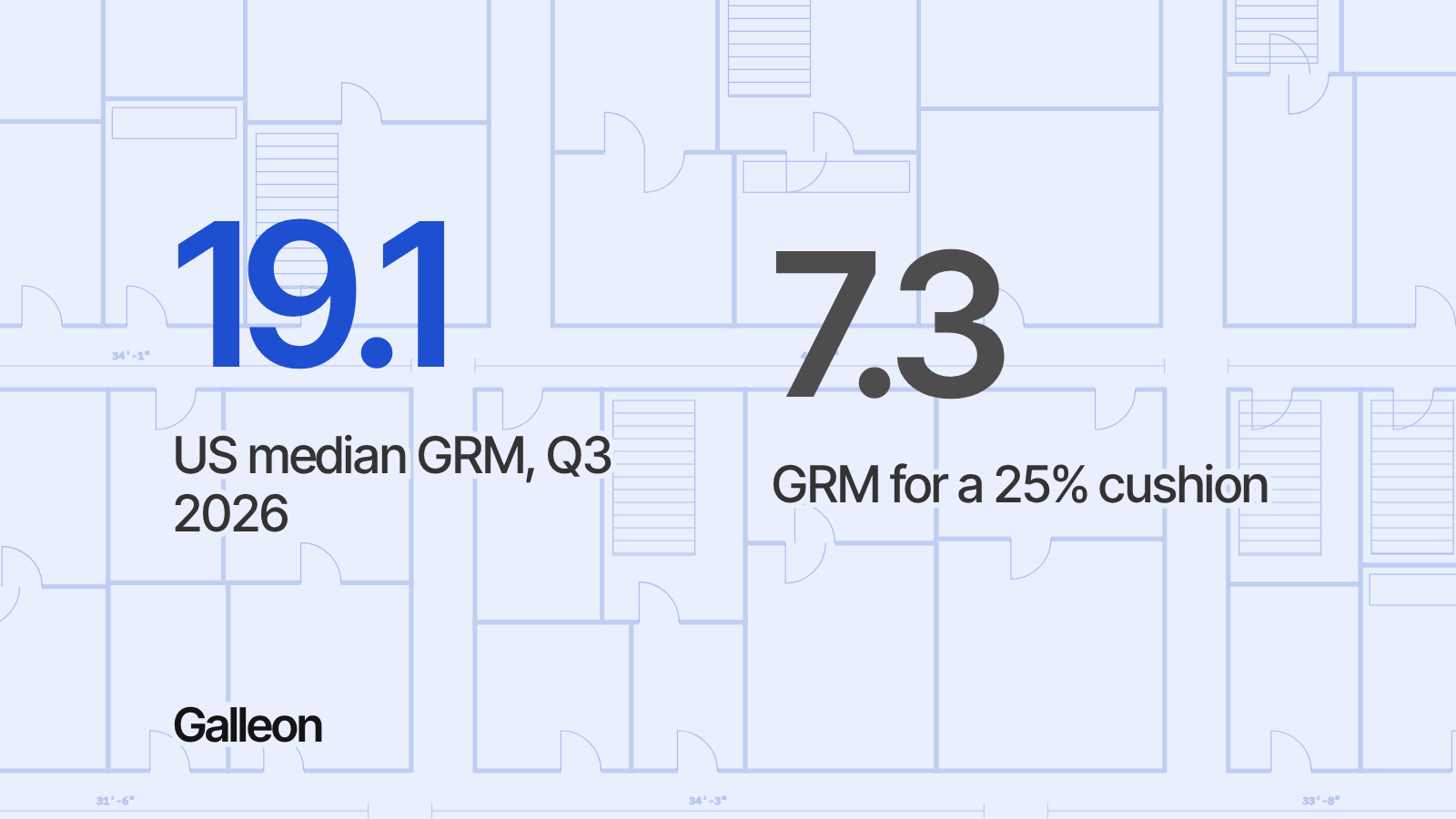
- Using Census medians for Q3 2026 ($353,600 asking price and $1,541 asking rent), the national annual GRM is about 19.1, far above the 4 to 7 range many investors call good.
- At a 7.18% rate (Freddie Mac, as of November 2026) with 25% down, 40% expenses and 7.6% vacancy, a rental needs a GRM of about 7.3 to cover principal and interest with a 25% cushion.
- GRM only compares similar properties in the same market, so treat it as a first filter and follow it with cap rate, cash flow and DSCR.
How do you calculate the gross rent multiplier?
GRM is one division: price ÷ gross annual rent. Gross annual rent is the full scheduled rent for 12 months, before vacancy, repairs, taxes, insurance or the mortgage.
Say a duplex is listed at $420,000 and each side rents for $1,750 a month. That's $42,000 a year in gross rent, so the GRM is $420,000 ÷ $42,000 = 10.0. In plain terms, you're paying 10 years of gross rent for the building.
It also works backward. If similar duplexes nearby sold at a GRM of 9, this one's rent supports a price around $378,000 ($42,000 × 9).
Lower is better when you're buying, but only when you compare like with like: similar property types, in the same market, at about the same time.
Monthly vs. annual GRM: why an appraisal shows 229
If you've seen a GRM of 120 or 229 on an appraisal and thought it was a typo, it isn't. Fannie Mae's appraisal report form runs its income approach as "Estimated Monthly Market Rent × Gross Rent Multiplier = Indicated Value by Income Approach." That's a monthly GRM: price divided by one month of rent. The form marks this approach as not required by Fannie Mae and asks the appraiser to support both the market rent and the multiplier.
Monthly GRM is always 12 times the annual one.
| Annual GRM | Monthly GRM | What it lines up with |
|---|---|---|
| 4.17 | 50 | The 2% rule |
| 7 | 84 | Top of the "good" range you'll often read |
| 8.33 | 100 | The 1% rule |
| 10 | 120 | Our duplex example |
| 19.1 | 229 | US median asking price vs. median asking rent, Q3 2026 |
Watch out: Don't compare a monthly GRM from an appraisal with an annual GRM from a broker or a blog. Divide the monthly figure by 12 first.
What is a good gross rent multiplier?
You'll often read that a good GRM is between 4 and 7. We couldn't find a source for that range, so we checked it against national data.
The Census Bureau's Q3 2026 vacancy report puts the median asking rent for vacant rentals at $1,541 a month and the median asking price for vacant homes for sale at $353,600 (as of October 2026). Here's what those give you:
| Measure (US, Q3 2026) | Value |
|---|---|
| Median asking price | $353,600 |
| Median asking rent | $1,541 a month |
| Gross annual rent | $18,492 |
| Annual GRM | 19.1 |
| Monthly GRM | 229 |
| Monthly rent as a share of price | 0.44% |
Source: U.S. Census Bureau, Housing Vacancies and Homeownership, released October 28, 2026.
One caveat: these are asking prices for homes for sale and asking rents for vacant rentals, so they aren't the same properties. Treat 19.1 as a rough direction. Even so, the typical home is asking almost three times the top of the "good" range.
The 4 to 7 range holds up better than you'd expect, though. As the next section shows, it lines up closely with what a financed rental needs to pay for itself at today's rates.
What GRM does a rental need to cash-flow at today's rates?
You can turn your loan terms into a target GRM. Here's the formula in plain words:
Target GRM = (share of rent you collect × share left after expenses) ÷ (coverage × loan-to-value × mortgage constant)
The mortgage constant is one year of principal and interest per dollar borrowed. At 7.18%, the 30-year fixed average from Freddie Mac's weekly survey for the week ending November 5, 2026, it's 0.0813. Coverage is how many times the rent left after expenses covers the loan payment: 1.0 just breaks even, and 1.25 leaves a 25% cushion. That's a common minimum for DSCR loans, though many DSCR lenders divide rent by the full payment including taxes and insurance, so check your lender's method.
Our inputs: 7.6% vacancy (the Census national rental vacancy rate, as of October 2026), a 30-year loan at 7.18% (as of November 2026), and 40% or 45% of collected rent going to taxes, insurance, repairs, management and reserves. That expense share is our assumption, so change it to match your property.
| Down payment | Expenses | Break-even GRM (1.0x) | GRM for a 25% cushion (1.25x) |
|---|---|---|---|
| 25% | 40% | 9.1 | 7.3 |
| 20% | 40% | 8.5 | 6.8 |
| 25% | 45% | 8.3 | 6.7 |
| 20% | 45% | 7.8 | 6.3 |
Example. Inputs: 7.18% 30-year rate (Freddie Mac, Nov 5, 2026), 7.6% vacancy (Census, Q3 2026), expense shares are assumptions.
At today's rates, the 4 to 7 range is roughly what a financed rental needs to pay its own way. The typical home is asking closer to 19.
Two things move the target. First, Freddie Mac's rate is for borrowers with 20% down and strong credit, and investor loans are priced separately, so plug in the rate from your own lender's quote. Second, vacancy matters: at 25% down and 40% expenses, the 1.25x GRM runs from 7.1 in the South (9.2% vacancy) to 7.4 in the Northeast (6.2% vacancy).
How GRM connects to the 1% rule, the 2% rule and cap rate
All the quick screens are the same idea wearing different clothes. GRM = 1 ÷ (12 × monthly rent as a share of price). That means:
- The 1% rule (monthly rent equal to 1% of price) is a GRM of 8.33.
- The 2% rule is a GRM of 4.17.
- The national median, at 0.44% a month, is the 19.1 from above.
Cap rate links in too: cap rate ≈ (1 − vacancy) × (1 − expense ratio) ÷ GRM. At a GRM of 19.1 with 7.6% vacancy and 40% expenses, that's a 2.9% cap rate (3.1% if expenses run 35%). Our cap rate guide walks through the full calculation.
Is a 3% cap rate good?
With a loan at today's rates, it's hard to make work. A 3% cap rate is what you get at a GRM of about 18.5 (with 7.6% vacancy and 40% expenses). With mortgages near 7.18%, the money you borrow costs more than the property earns, so every borrowed dollar pulls your return down.
Here's that in dollars. Put 25% down on the $353,600 median home and you borrow $265,200. Principal and interest at 7.18% come to about $1,797 a month, which is $256 more than the $1,541 median rent, before you pay anything toward taxes, insurance or repairs.
Worked example: using GRM to set a max offer on a fourplex
GRM is most useful backward. Start from the rent and your target GRM, and you get the most the numbers can support.
- Pull rent for each unit. We'll use the $1,541 national median, but swap in your local rent comps.
- Find gross annual rent: 4 × $1,541 × 12 = $73,968.
- Check the asking price. A fourplex listed at $740,000 has an annual GRM of 10.0 (a monthly GRM of 120).
- Multiply gross rent by your target GRM from the table above.
| Target | GRM | Price the rent supports |
|---|---|---|
| 25% cushion (1.25x), 25% down, 40% expenses | 7.3 | $539,966 |
| Break-even (1.0x), 25% down, 40% expenses | 9.1 | $673,109 |
| Asking price | 10.0 | $740,000 |
Example, not a real listing. Rent from Census Q3 2026 median; rate from Freddie Mac, Nov 5, 2026.
At these rents, the price would need to come down about $200,000 to reach a 1.25x cushion. Or rents would need to be about $2,112 per unit to get there at $740,000. A bigger down payment, a lower rate or real expenses below 40% would also close part of the gap. Either way, you know in a couple of minutes whether the listing deserves a full underwrite.
What's the difference between GRM and GIM?
The gross income multiplier (GIM) divides price by rent after vacancy (some people also add other income like laundry or parking). For the national median home, $18,492 of gross rent less 7.6% vacancy leaves $17,087, so the GIM is 20.7 against a GRM of 19.1. GIM helps when you compare regions, since the same GRM buys less collected rent where vacancy runs higher.
What GRM leaves out, and what to run next
GRM sees only price and gross rent. It misses:
- Operating costs, which can differ a lot between two buildings with the same rent (an old roof, owner-paid utilities)
- Vacancy and turnover in your submarket
- Your loan terms
- Condition and big repairs coming up
- Other income
Use GRM to rule out listings fast. For the ones that pass, analyze the rental property properly:
- Cap rate
- Cash flow at your loan terms
- Cash-on-cash return
- DSCR
If you look at a lot of listings, that second pass is where the hours go. It's the job of the Buy Box Agent in Operator, the system of record for your properties. It screens new listings in your markets overnight, pulls insurance estimates and rent comps for each one, and runs cash flow at your financing terms, so you start the day with the deals that fit your numbers.
Last updated November 11, 2026. Rates and Census figures change; check the linked sources for the latest.
This is general information, not tax, legal or lending advice. Talk to your CPA, attorney or lender about your situation.
FAQ
How do you calculate the gross rent multiplier?
Divide the price by gross annual rent. A $420,000 duplex with $42,000 a year in rent has a GRM of 10.0. For a monthly GRM, like the one on an appraisal, divide by one month of rent instead.
What is a good gross rent multiplier?
Many investors call 4 to 7 good, usually without a source. At a 7.18% rate (as of November 2026), with 25% down, 40% expenses and 7.6% vacancy, a rental needs a GRM of about 7.3 to cover principal and interest with a 25% cushion, and about 9.1 to break even. What counts as good depends on your loan terms and your market.
Is a higher or lower GRM better?
Lower is better for a buyer, because you pay less for each dollar of rent.
What's the difference between GRM and cap rate?
GRM uses gross rent and ignores expenses. Cap rate uses net operating income (rent after vacancy and expenses) divided by price. You can estimate one from the other: cap rate ≈ (1 − vacancy) × (1 − expense ratio) ÷ GRM. At a GRM of 19.1, that's about a 2.9% cap rate.
Why is the GRM on my appraisal over 100?
Appraisers using Fannie Mae's form apply a monthly GRM: price divided by one month of rent. Divide it by 12 to compare it with the annual GRM most investors use. A monthly 120 equals an annual 10.