AI agents for real estate investors are programs that do a job on a schedule, check the results against rules you set and send you what passes without being asked. For a small landlord, the two jobs they handle well today are screening new listings against your buy box overnight and flagging units whose rent has drifted below market.
Key takeaways
- A chatbot answers when you ask, while an AI agent works on a schedule and comes to you with results.
- The simplest test for a real AI agent is whether it did useful work today that nobody asked it to do.
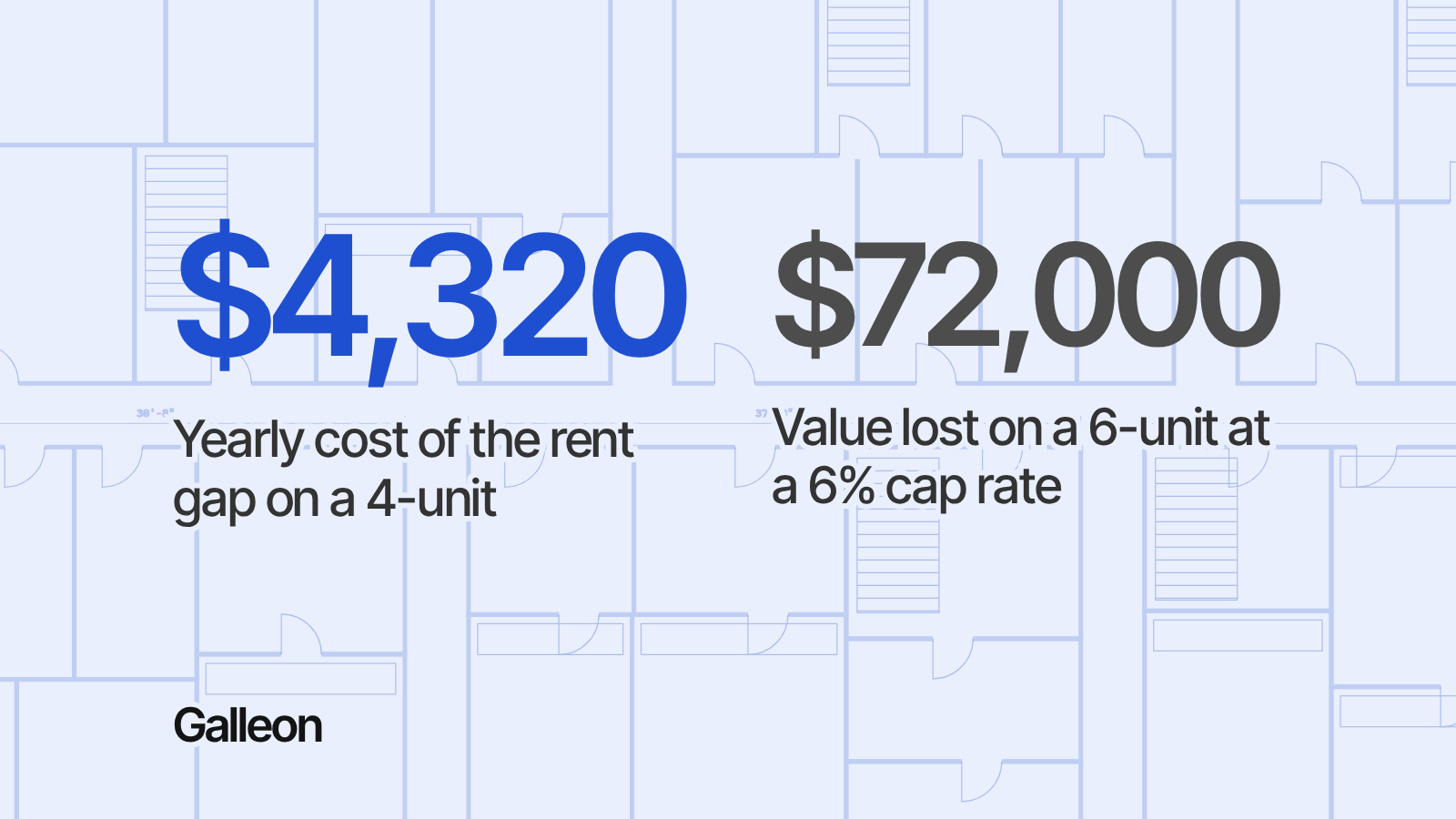
- In our example, two units renting $180 a month below market on a 6-unit building at a 6% cap rate cost $4,320 a year in income and about $72,000 in building value.
- On a 1 to 4 unit property, the same gap mostly costs you the lost income, because those buildings are generally valued by comparable sales.
- AI agents are only as good as the county and listing data behind them, so treat every match as a lead to check.
- The software screens and flags, and you make the calls, especially anything that touches tenants.
What is an AI agent for real estate investors?
Most search results for "real estate AI agent" are written for realtors: lead follow-up, listing videos and virtual staging. Investors need something different. For you, an AI agent is software that handles a repeat task in your business while you're busy with other things. You give it standing rules once (your markets and price range, for example), and it runs every day, checks what it finds against those rules and sends you only what matters.
The word "agent" gets stretched a lot. Plenty of tools that call themselves agents are a chat window with a new label, which is why many investors are skeptical of the whole category. It helps to sort tools into three groups.
AI agent vs. AI assistant vs. automation
How the three types of tools compare for a rental investor
| Type | What starts it | Investor example | What you still do |
|---|---|---|---|
| AI assistant (chatbot) | You type a question | "What's the cap rate on this listing at $625,000?" | Find the listing, supply the numbers, ask again tomorrow |
| Automation | A fixed trigger | "Email me any new listing in my ZIP code under $400,000" | Sort every alert by hand, since the rule never thinks |
| AI agent | A schedule plus standing rules | Each night, check new listings in your ZIP codes, pull taxes, insurance and rent comps, run cash flow at your loan terms and send the few that pass | Review a short list and decide |
An AI assistant is still useful. It can explain a term, draft a renewal letter or sanity-check your math. But it waits for you, and if you don't open it, nothing happens. An automation runs without you, but it's blunt: it forwards everything that matches one filter and leaves all the judgment to you. An AI agent gathers the data, does the analysis and filters the results before you ever see them.
The "nobody asked" test
When a tool says it's an AI agent, ask three questions:
- Does it run on its own schedule? If it only works when you open it and type, it's an assistant.
- Does it check results against your standing rules? Your buy box and loan terms should be saved once and used every day.
- Does it bring the output to you? An email in the morning or an alert before a lease renews means you don't have to go looking.
If all three answers are yes, the tool did useful work today that nobody asked it to do. That's the bar. If you're still the one starting every task, you've bought a faster calculator, which can be fine, but price it like one.
Which investor jobs can AI agents actually do?
For buy-and-hold investors, two jobs fit well. Both are boring, both repeat daily, and both cost you money when you skip them.
Screening deals
New listings show up every day. Checking each one against your criteria, then pulling taxes, insurance and rent comps to run the numbers, is exactly the work most people quit after a few weeks. An AI agent does it every night. You still need to know how to analyze a rental property yourself, because you're the one deciding which matches deserve an offer.
Watching rents on what you own
Market rents move, and leases renew on their own clock. Unless you pull comps for every unit before every renewal, some units quietly fall behind. An AI agent can compare each unit with market comps and flag the gap before the renewal date, while you still have time to act. If you've never run comps on your own units, our guide to rental comparable market analysis walks through it.
What AI agents shouldn't do
Keep software out of deciding who gets to rent from you. Tenant screening and other tenant-facing decisions carry fair-housing risk when a program makes the call, and tenants are the clients your whole business runs on. A person should own those decisions.
What does rent drift cost a small landlord?
The same rent gap costs very different amounts depending on the size of the building. Residential properties with 1 to 4 units are generally valued by comparable sales. At 5 or more units, value follows net operating income (NOI), so lost rent divided by the cap rate comes off the building's value.
Here's an example. You own 10 doors: a 6-unit building and a 4-unit building. In each one, two units rent $180 a month below current market comps. Assume a 6% cap rate on the 6-unit.
Example: the same $180 rent gap on two buildings Hypothetical. Assumes 2 units per building at $180/mo below market and a 6% cap rate on the 6-unit.
| 4-unit building | 6-unit building | |
|---|---|---|
| How it's usually valued | Comparable sales | NOI ÷ cap rate |
| Units below market | 2 | 2 |
| Gap per unit | $180/mo | $180/mo |
| Lost income per year | $4,320 | $4,320 |
| Value lost at 6% cap rate | No direct effect | $72,000 |
The income math is the same on both: 2 units × $180 × 12 months = $4,320 a year. On the 6-unit, divide $4,320 by 0.06 and you get $72,000 less building value. That's because each $1 of monthly rent is $12 a year, and $12 ÷ 0.06 is $200.
At a 6% cap rate, every $1 a month of missed rent on a 5+ unit building takes about $200 off its value.
That shows up when you refinance or sell, because a lender or buyer looking at income works from the rents in place. The gap also lowers your debt service coverage ratio, the number behind a DSCR loan that tells a lender whether rent covers the payment.
Watch out: A rent alert tells you where to look. Before you change a renewal, weigh what a good, long-term tenant is worth to you, since a turnover can easily cost more than the gap.
How Operator's agents handle these two jobs
Operator is our system of record for your real estate portfolio, the place you track what you own and how it grows. It runs two agents today, the Buy Box Agent and the Rent Monitoring Agent. Neither one screens tenants or changes rents on its own. The agents do the screening, and you make the calls.
The Buy Box Agent screens new listings in your markets overnight and has matches in your inbox by 6:00 a.m. For each listing, Galleon pulls county tax bills, insurance estimates and rent comps, then runs cash flow at your financing terms. Each match gets a 0 to 100 score for how well it fits your buy box, so you can save it for analysis or pass.
The Rent Monitoring Agent compares each unit's rent with market comps and sends a rent alert when a unit drifts below market before renewal, with the dollar impact attached. You can enter rentals by hand or import a CSV or XLSX file.
Does it pay for itself?
As of November 2026, Operator pricing is $49 a month for one buy box ($588 a year) and $149 a month for Operator PRO ($1,788 a year), which covers up to five buy boxes plus a view across markets and entities. Both include the two agents, and there's a 7-day free trial.
Example: one year of the rent gap above vs. the subscription Hypothetical. Assumes you close the full $4,320 gap at renewal. Prices as of November 2026.
| Plan | Annual cost | Rent gap closed | Net for the year |
|---|---|---|---|
| Operator | $588 | $4,320 | $3,732 |
| Operator PRO | $1,788 | $4,320 | $2,532 |
On the base plan, closing that one gap returns about 7.3 times the cost, and the break-even is a single unit renting $49 a month below market. Don't forget that this only counts if you actually close the gap at renewal, and that's your decision.
Where AI agents get it wrong
Every AI agent for real estate depends on outside data, and that data has holes. Here's where we'd stay alert:
- Patchy county records. Seller signals come from public records, and counties don't all record or publish the same things. A missing signal doesn't mean an owner isn't motivated.
- Estimated values miss. An automated value is a starting point. Check it against your own sales comps before you trust a "below value" headline, especially on small multifamily.
- Matches that pass on paper. A listing can clear every filter and still need a new roof. Rules can't see condition, so walk the property before you count on the numbers.
- Lagging listing data. Price cuts and pulled listings don't always show up right away, so confirm the status before you call.
- Tenant-facing calls. Anything that decides who rents from you belongs with a person, for fair-housing reasons and because it's how you treat clients well.
Last updated: November 8, 2026. Prices and features change, so check current terms before you rely on them.
This is general information, not tax, legal or lending advice. Talk to your CPA, attorney or lender about your situation.
FAQ
Can I build my own AI agent with ChatGPT and Zapier?
You can rig up a prompt that analyzes a listing you paste in, and you can schedule it. The hard part is the data. You'd still need a daily listings feed for your markets, county records for seller signals like tax delinquency, and rent comps for every unit you own. Without those inputs, a homemade setup is an assistant on a timer.
Will an AI agent replace my property manager?
No. The AI agents covered here handle analysis and monitoring. They don't collect rent, handle maintenance or screen tenants, and those jobs still need a person.
Is an AI agent worth it with only a few doors?
Run the math the way we did above. Compare a year of the subscription with one rent gap you'd likely miss or one deal you'd never have found. If a single unit renting below market covers the cost, a few doors can be enough.
What's the difference between an AI agent and a real estate agent?
A real estate agent is a licensed person who helps you buy or sell. An AI agent is software that runs a task on a schedule, like screening listings or checking rents, and reports back to you.
How accurate are AI deal matches?
They're only as accurate as the county records, listing data and value estimates behind them. Treat every match as a lead: verify the value with your own comps, confirm the listing is still active and inspect before you commit.