An ARV calculator estimates what a property will be worth after the rehab by multiplying its square footage by the average price per square foot of 3 to 5 recently sold, renovated homes nearby. For buy-and-hold and BRRRR investors, ARV matters because the refinance appraisal sets the size of your new loan, and that loan decides how much of your cash comes back out.
Key takeaways
- ARV (after repair value) is an estimate of what a property will appraise or sell for once the work is done, based on recent sales of similar renovated homes.
- For a BRRRR, the ARV that counts is the number the refinance appraiser writes down, because the lender sizes your new loan from it.
- Cash left in a BRRRR equals your all-in cost minus (appraised value × the lender's max cash-out loan-to-value).
- In our example, a 10% low appraisal more than doubles the cash left in the deal, from $16,250 to $34,625.
- Under Fannie Mae rules, a BRRRR bought with a hard-money loan usually can't do a cash-out refinance until that first loan is 12 months old.
What does an ARV calculator calculate?
ARV stands for after repair value. It's what the property should be worth once the rehab is finished, judged against homes that already look the way yours will. The basic formula is:
ARV = your property's square footage × average price per square foot of renovated comps
Some calculators use "purchase price + renovation cost" instead. Skip that version. An appraiser won't add up your receipts, so a $40,000 kitchen on a street of dated houses won't raise the value by $40,000 just because you paid for it.
Our ARV calculator handles the comp math. The part that takes judgment is choosing the comps.
How do you pick comps the way an appraiser would?
Most ARV guides are written for flippers and stop at the formula. A BRRRR lives or dies on the appraisal, so pull comps the way the appraiser will:
- Use sold homes only. Listings tell you what sellers hope for.
- Match the finish level. Only renovated sales belong in your ARV. The dated house next door tells you the as-is value instead.
- Stay close and similar. Same neighborhood, with similar beds, baths, square footage and age.
- Keep them recent. Use the newest 3 to 5 sales you can find, and reach further back only when you have to.
- Toss the oddballs. Estate sales, family transfers and the one house with a pool will pull your average the wrong way.
Average the price per square foot of what's left, then multiply by your property's square footage. Our guide to a comparable market analysis goes deeper, including how to pull rent comps alongside sales comps.
How does ARV decide your BRRRR refinance?
In a BRRRR deal, you buy, rehab, rent, refinance and repeat. The refinance is where ARV turns into cash. The lender orders an appraisal, then lends a set percentage of it, called the maximum cash-out loan-to-value (LTV). Whatever you spent above that loan amount stays in the deal as your money.
Here's the rule we use for rentals:
Cash left in the deal = all-in cost - (appraised value × max cash-out LTV)
Turn it around and you get the most you can spend and still pull every dollar back out: ARV × max LTV.
Max LTV depends on the lender, the loan program and the number of units, and some programs set a lower limit for 2 to 4 units. Ask your lender for their current limit before you run anything. We use 75% for the single-family example below.
Worked example: a $245,000 ARV BRRRR
This is a made-up single-family deal, so swap in your own comps and contractor quotes.
| Input | Example |
|---|---|
| Property | 3 bed, 2 bath, 1,400 sq ft |
| Renovated comps, average price per sq ft | $175 |
| ARV (1,400 × $175) | $245,000 |
| Purchase price | $150,000 |
| Rehab budget | $40,000 |
| Contingency (10% of rehab) | $4,000 |
| Closing and holding costs | $6,000 |
| All-in cost | $200,000 |
| All-in as a share of ARV | 81.6% |
| Refi loan at 75% LTV | $183,750 |
| Cash left in the deal | $16,250 |
That $16,250 is before the refinance's own closing costs, which add to what stays in. To get all of your cash back at 75% LTV, you'd need to keep the all-in cost at or below $183,750.
If your lender capped cash-out at 70% instead, the loan would be $171,500 and $28,500 would stay in. Don't forget to change the LTV to your lender's actual number before you trust the result.
What happens if the appraisal comes in low?
This is where an optimistic ARV costs you. Say the appraiser lands 10% under your estimate, at $220,500.
| Appraisal matches ARV | Appraisal 10% low | |
|---|---|---|
| Appraised value | $245,000 | $220,500 |
| Refi loan at 75% LTV | $183,750 | $165,375 |
| Cash left in the deal | $16,250 | $34,625 |
A $24,500 miss on value leaves $18,375 more of your cash in the house, which more than doubles what's stuck. That's money you were counting on for the next down payment.
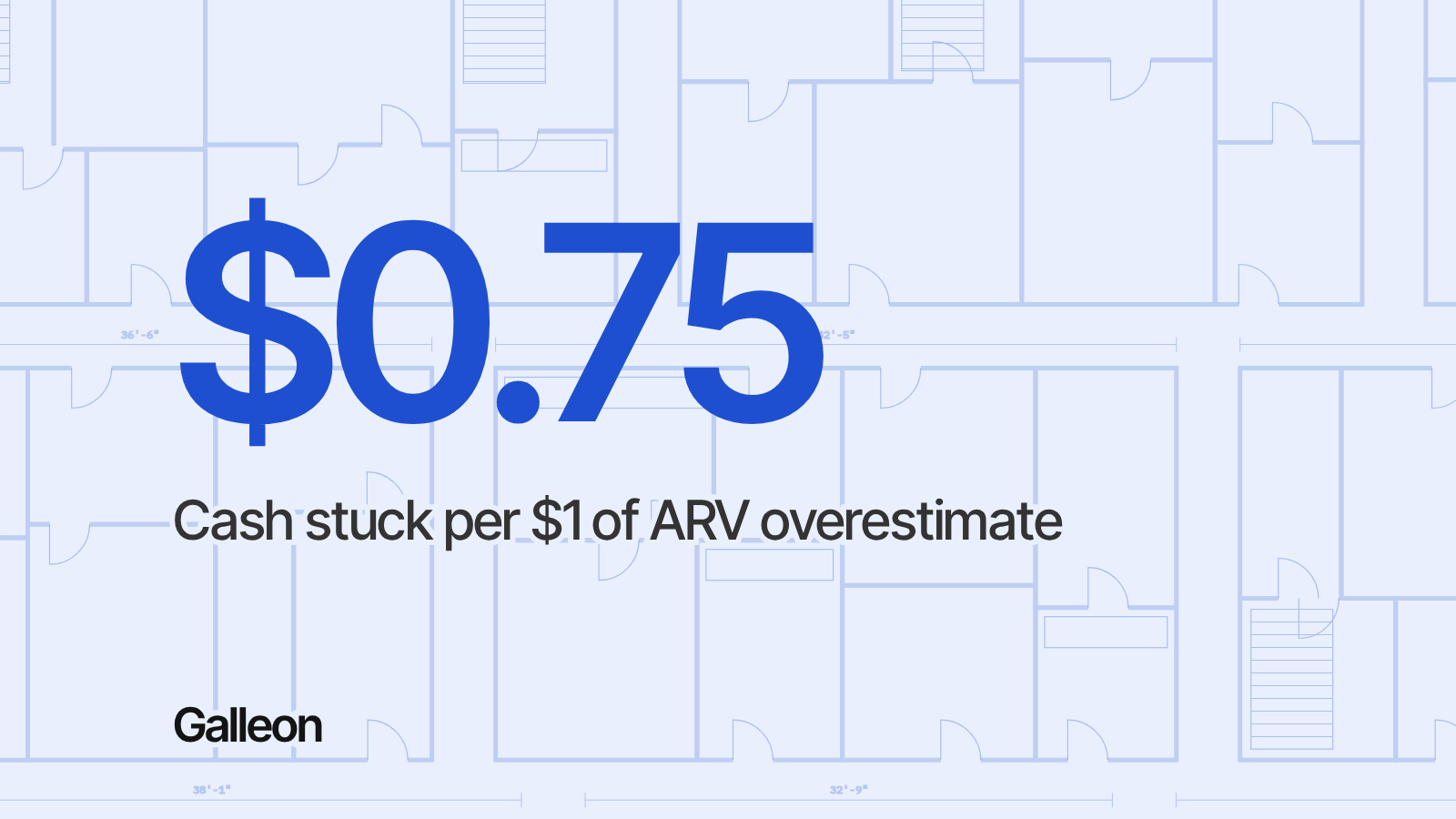
At 75% LTV, every $1 your ARV is too high leaves $0.75 more of your own cash in the deal.
Two habits help. First, build your ARV from the most conservative comps that still fit, so a surprise is more likely to be good news. Second, if you think the appraiser missed better comps, ask your lender how they want you to send them in.
Why the 70% rule doesn't fit a rental
Flippers use a maximum allowable offer: ARV × 70% minus repairs. On our example, that's $245,000 × 70% minus $44,000 in rehab and contingency, or $127,500. The 30% gap pays for a flipper's selling costs and profit.
A buy-and-hold investor keeps the house, so the number that matters is the refi loan. By the refi rule, the full cash-back cap on all-in cost is $183,750. The deal above fails the 70% test at a $150,000 price, yet it leaves only $16,250 in at refinance. Whether that's acceptable depends on the rent and your goals, which is a better question to ask than whether it clears a flipper's margin.
When can you refinance a BRRRR?
Your ARV can be perfect and the refi can still wait on the calendar. Under the Fannie Mae Selling Guide section on cash-out refinances (version dated December 10, 2025):
- At least one borrower must have been on title for at least 6 months before the new loan funds. If an LLC you majority own or control held the property, its time on title counts, but title has to move to you before closing.
- Any first mortgage being paid off must be at least 12 months old, measured note date to note date. So if you bought with a hard-money loan, month 12 is usually the earliest you can do an agency cash-out refi.
- If your debt-to-income ratio is above 45%, Fannie's automated underwriting requires 6 months of reserves on a cash-out loan.
Watch out: If you bought with cash, Fannie's delayed financing exception lets you refinance within 6 months, but the new loan can't exceed your documented investment in purchasing the property plus closing costs, prepaid fees and points on the new loan. The purchase must be arm's length with no mortgage on the settlement statement. Don't count on getting rehab money back this way, and confirm with your lender how they read the rule.
If 12 months is too long to wait, many investors look at a DSCR loan, where seasoning and LTV follow each lender's own rules. Ask each lender directly what they allow and whether they'll lend on the appraised value before month 12.
When you do go to the lender, it helps to have each property's numbers in one place. Operator, our system of record for the properties you own, has a BRRRR calculator and lender-ready PDF exports you can hand over at the refi.
What refi rate should you plug in?
Freddie Mac's Primary Mortgage Market Survey put the 30-year fixed rate at 7.11% as of November 12, 2026, down from 7.18% the week before. That survey covers conventional purchase loans for borrowers with 20% down and excellent credit, so treat it as a best case.
A cash-out refi on a rental usually prices above that average. We don't have a sourced premium, so we ran an example at 0.75 percentage point above the survey.
| Refi rate (30-year) | Monthly principal and interest on $183,750 |
|---|---|
| 7.11% (Freddie Mac average, Nov 2026) | $1,236 |
| 7.86% (example rental premium) | $1,330 |
That's $94 a month more your rent has to cover, before taxes, insurance and any HOA dues. Get a real quote from your lender and use that instead.
Does ARV change your depreciation?
No. Depreciation runs off what you paid and what you spent. Per IRS Publication 527, residential rental buildings are depreciated straight-line over 27.5 years, and improvements use the same 27.5 years. In our example, your basis starts from the $150,000 purchase (minus the land) plus what you actually spend on improvements, even though the house appraises at $245,000. If you spend the full $44,000 and it all counts as an improvement, that piece depreciates at about $1,600 a year. Your CPA decides what's an improvement and what's a repair.
This is general information, not tax, legal or lending advice. Talk to your CPA, attorney or lender about your situation. Last updated November 16, 2026.
FAQ
What is ARV in real estate?
ARV, or after repair value, is what a property should be worth once renovations are done. You estimate it from recent sales of similar, already renovated homes nearby.
Is ARV the same as the appraised value?
Not always. ARV is your estimate before or during the rehab. The appraised value is what the lender's appraiser concludes at refinance, and that's the number your loan is based on. The closer your comps match what an appraiser would pick, the closer the two will be.
How do I calculate ROI on a BRRRR?
Most investors use cash-on-cash return: the property's yearly cash flow after the refi payment, divided by the cash you left in the deal. The less cash left in, the higher that return, which is why an accurate ARV matters so much.
How do I estimate what my house is worth?
Average the price per square foot of 3 to 5 recent sales of similar homes nearby, then multiply by your square footage. Online estimates are a fine starting point, but sold comps are what an appraiser will rely on.
Can I get my rehab money back with delayed financing?
Usually not under Fannie Mae's rules. The delayed financing exception caps the new loan at your documented investment in purchasing the property plus closing costs on the new loan, so ask your lender how they treat rehab costs before you plan around it.