The Zillow rent estimate (Zillow calls it the Rent Zestimate) is a useful first guess, but it isn't precise enough to underwrite a rental on its own. Check it against four or five recent local comps, adjusted for move-in deals and condition, before you put it in your numbers.
Key takeaways
- The Rent Zestimate is Zillow's formula-based guess at what a home would rent for each month, and Zillow says actual rents can differ from it.
- As of November 2026, we couldn't find a current published error rate for the Rent Zestimate, so you can't look up how close it usually gets.
- Accuracy figures you see quoted for the Zestimate usually describe home sale values, which tell you nothing about rent.
- In our example, a $120 a month gap between the Rent Zestimate and comps adds up to $1,440 a year and about $20,600 of value at a 7% cap rate.
- A five-comp check (same beds, similar size, nearby, recent, adjusted for deals and condition) takes about 20 minutes and catches most misses.
What is the Zillow rent estimate?
The Rent Zestimate is Zillow's estimate of what a home would rent for each month. Per the Zillow help center, it's computed with a formula that uses the home's facts, its location and comparable rentals nearby. Zillow also says rents can vary with "negotiation factors, special incentives, and length of lease," and that the estimate may not capture special features or local conditions.
That's a fair description of any rent model. It sees what public records and listings show, and it misses what only you can see by walking the home or calling the landlord down the street.
How accurate is the Zillow rent estimate?
Zillow doesn't make this easy to answer. Its help center points to accuracy data, but as of November 2026 we couldn't find a current national error figure for the Rent Zestimate.
You'll often see accuracy numbers quoted in articles about Zillow rent. Look closely and they're usually about the home value Zestimate, which estimates sale prices. A model can be good at sale prices and loose on rent (or the other way around), so those numbers don't answer the rent question.
The practical answer is to test it yourself on each deal. One pattern to keep in mind: investors mostly look up homes that aren't listed for rent yet. With no current listing to learn from, any model has the least to go on, which is exactly when you need the number to be right. For more on how these models work, see our guide to automated valuation models.
Why does the Rent Zestimate drift from real rent?
Here's how Zillow's own caveats play out for an investor:
- It can miss move-in deals. Zillow says special incentives affect rent. A listing at $1,995 with one free month on a 12-month lease really brings in about $1,829 a month.
- Public records can be wrong. If the county has the wrong bathroom count or square footage, the estimate starts from the wrong place.
- Thin data makes it shakier. A rural ZIP or a street of mostly owner-occupied homes gives the model few nearby rentals to compare against.
- It can't see condition. An original 1998 kitchen and a fresh remodel can look the same in public data.
- Timing is unclear. We couldn't find a published refresh schedule for the Rent Zestimate as of November 2026, so it may lag seasonal swings.
Zillow gives you a guess. Your adjusted comps show what tenants will actually pay.
Worked example: Rent Zestimate vs. five comps
Here's the check on a made-up property, 418 Larkspur Bend. It's a 3-bed, 2-bath single-family home, 1,450 square feet, built in 1998 with the original kitchen, and it's off-market. The buyer owns about 6 doors and wants to know what rent to underwrite.
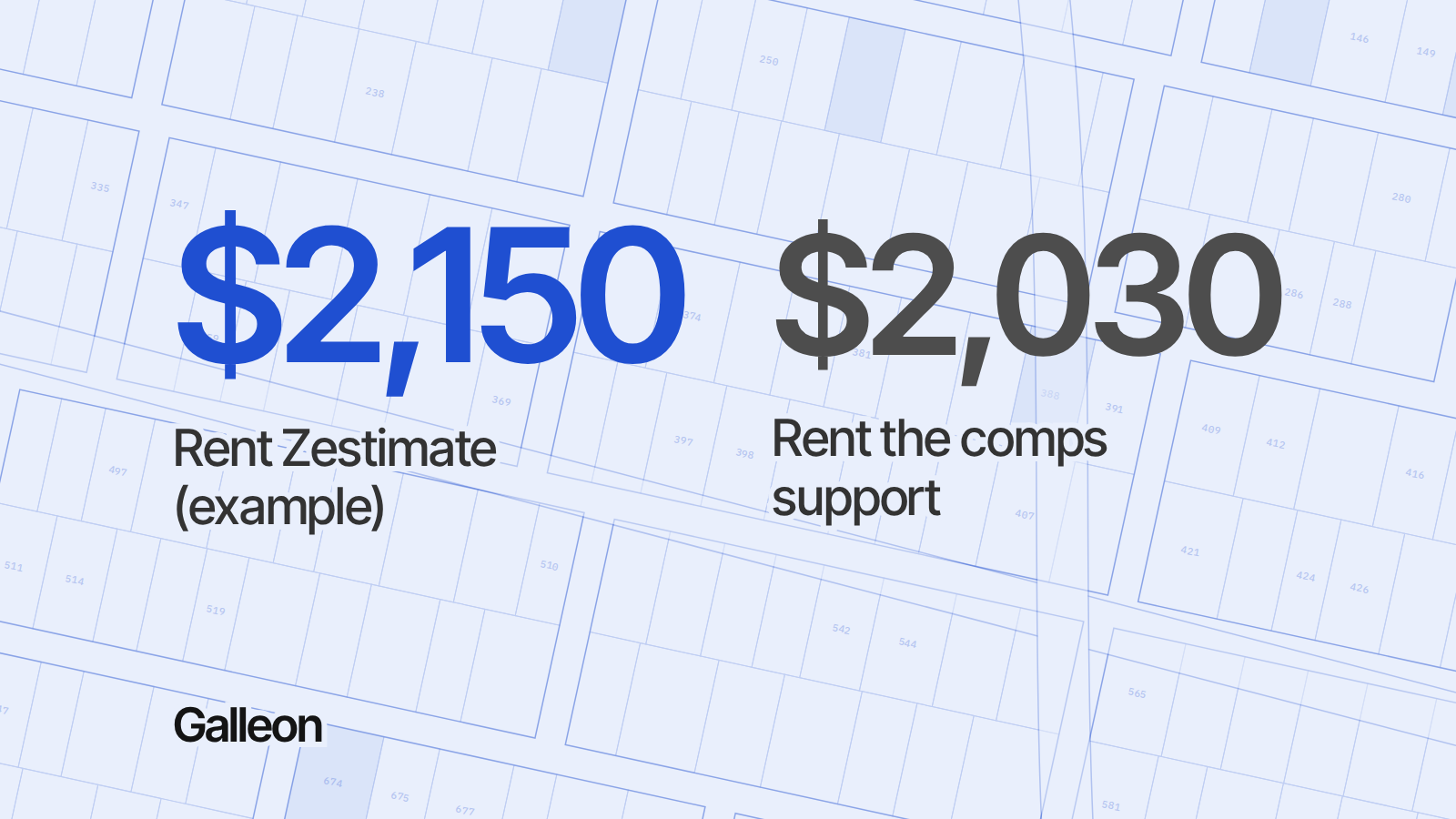
Zillow shows a Rent Zestimate of $2,150, with a low-to-high range of $1,700 to $2,600. That's about ±21% around the estimate, which tells you the model itself isn't confident.
Next we pull comps: 3 bedrooms, within about 20% of the square footage, within about a mile, listed or rented in the last 60 days. All rents below are an example, not live listings.
| Comp | Beds/baths | Sq ft | Listed rent | Notes | Effective rent | Effective $/sq ft |
|---|---|---|---|---|---|---|
| C1 | 3/2 | 1,380 | $1,995 | 1 month free on 12-month lease, 34 days listed | $1,828.75 | $1.33 |
| C2 | 3/2 | 1,520 | $2,100 | Rented in 12 days | $2,100 | $1.38 |
| C3 | 3/2.5 | 1,600 | $2,250 | Renovated kitchen, 9 days (left out) | $2,250 | $1.41 |
| C4 | 3/1 | 1,300 | $1,850 | After a $100 price cut, 41 days | $1,850 | $1.42 |
| C5 | 3/2 | 1,450 | $2,095 | 21 days listed | $2,095 | $1.44 |
Example, not a quote. Effective rent spreads any free month across the lease.
Watch out: If a comp offers a free month, spread it over the lease before you compare. C1's $1,995 becomes $1,995 × 11 ÷ 12 = $1,828.75.
We leave out C3 because its renovated kitchen makes it a nicer home than ours. The median of the four we keep is $1.40 per square foot, and $1.40 × 1,450 square feet comes to about $2,030 a month. Leaving C3 in would nudge that to about $2,039, which shows how one nicer comp pulls the number up.
What the gap costs
| Measure | Amount |
|---|---|
| Rent Zestimate | $2,150 |
| Rent supported by comps | $2,030 |
| Monthly gap | $120 (about 6%) |
| Yearly gap | $1,440 |
| Value overstated at a 7% cap rate | about $20,600 |
| Yearly gap across 10 doors with a similar miss | $14,400 |
Example, not a quote. The 7% cap rate is an assumption for illustration.
Six percent sounds small, but if you price the deal off $2,150, you'd pay for about $20,600 of value the rent won't support. If you're unsure how that rent flows into your returns, our rental cash flow analysis walks through it.
Pricing too high costs money too
Say you buy anyway and list at $2,150. If that adds three extra weeks of vacancy, you lose about $1,405 ($2,030 × 12 ÷ 52 × 3). That's nearly the whole $1,440 first-year premium you were hoping to earn.
How to check a Zillow rent estimate in 5 steps
You can do all of this in a rental search site in about 20 minutes.
- Filter tight. Same bedroom count, square footage within about 20%, within about a mile, listed or rented in the last 60 days.
- Note days on market. Homes that rent in under two weeks show where demand is. Listings sitting 30+ days, or with price cuts, show the ceiling.
- Adjust for deals. Spread free months and other move-in offers over the lease term.
- Drop homes that don't match. Leave out comps that are clearly nicer or worse than yours (renovated kitchen, extra bath, no garage).
- Use the median price per square foot. Multiply it by your home's square footage, then compare that with the Rent Zestimate.
If the two are within a few percent, the Rent Zestimate is fine for a first pass. If they're further apart, trust the comps. Our guide to a comparable market analysis for rentals goes deeper on adjustments.
Use HUD Fair Market Rent as a floor check
HUD publishes Fair Market Rents for every county and metro, free on HUD User. HUD sets them at the 40th percentile of rents, and the FY2027 figures took effect October 1, 2026, per the Federal Register notice.
Because it's the 40th percentile, the FMR sits a bit below the middle of the market. If your comp-based rent comes in well below your area's FMR for the same bedroom count, you likely pulled weak comps or the location is softer than you thought. Don't treat the FMR as market rent, though. Use it as a sanity check, and remember that HUD's figure and a listing may not include the same utilities.
Where the Rent Zestimate helps and where it misleads
It helps when you're screening a lot of homes fast and need a rough rent to toss out the obvious misses, such as a quick 1% rule check. It also does better in busy rental areas with lots of similar listings nearby.
It misleads when you treat it as the rent you'll collect. That's most likely on off-market homes, in thin markets, when landlords nearby are offering free months, and when your home's condition differs from the neighbors'.
Keeping rent estimates current on homes you own
The five-comp check works well before you buy. The harder part is repeating it for every property you own, every year, as the market moves. Operator's Rent Monitoring Agent handles that repeat check: it compares each property's rent with market comps and sends a rent alert when they drift apart, so you know which homes to look at before a renewal.
Last updated November 15, 2026.
This is general information, not tax, legal or lending advice. Talk to your CPA, attorney or lender about your situation.
FAQ
Is the Zillow rent estimate accurate?
It's a reasonable first guess. As of November 2026 we couldn't find a current published error rate for the Rent Zestimate, and Zillow's help center says actual rents can differ because of incentives, lease length and special features. Check it against four or five recent local comps before you rely on it.
Why is my Rent Zestimate higher than my actual rent?
It can miss free months and other move-in deals nearby. Wrong home facts in public records and your home's condition can also push it off.
Can I change my Rent Zestimate?
You can't set the number yourself. If you own the home, you can claim it on Zillow and correct its home facts, which gives the formula better inputs.
How often does Zillow update the Rent Zestimate?
We couldn't find a published refresh schedule as of November 2026, so don't assume it reflects last month's market.
What rent should I underwrite if Zillow and my comps disagree?
Use the rent your adjusted comps support. If the two are within a few percent, either works for a first pass. If the gap is bigger, the comps win, because they reflect free months, condition and how fast similar homes actually rented.