Yes, you can use a HELOC for a down payment on a rental or second home, because Fannie Mae accepts borrowed money secured by your home as a down payment source. The catch is that the new lender must count the HELOC payment as debt, so the line has to fit your debt-to-income ratio and the rental has to carry two loans instead of one.
Key takeaways
- Fannie Mae treats money borrowed against your home as a return of your own equity, so it can pay for a down payment, closing costs and reserves.
- The lender on the new loan must count the HELOC payment in your debt-to-income ratio, and if the line has no required payment, the lender has to estimate one.
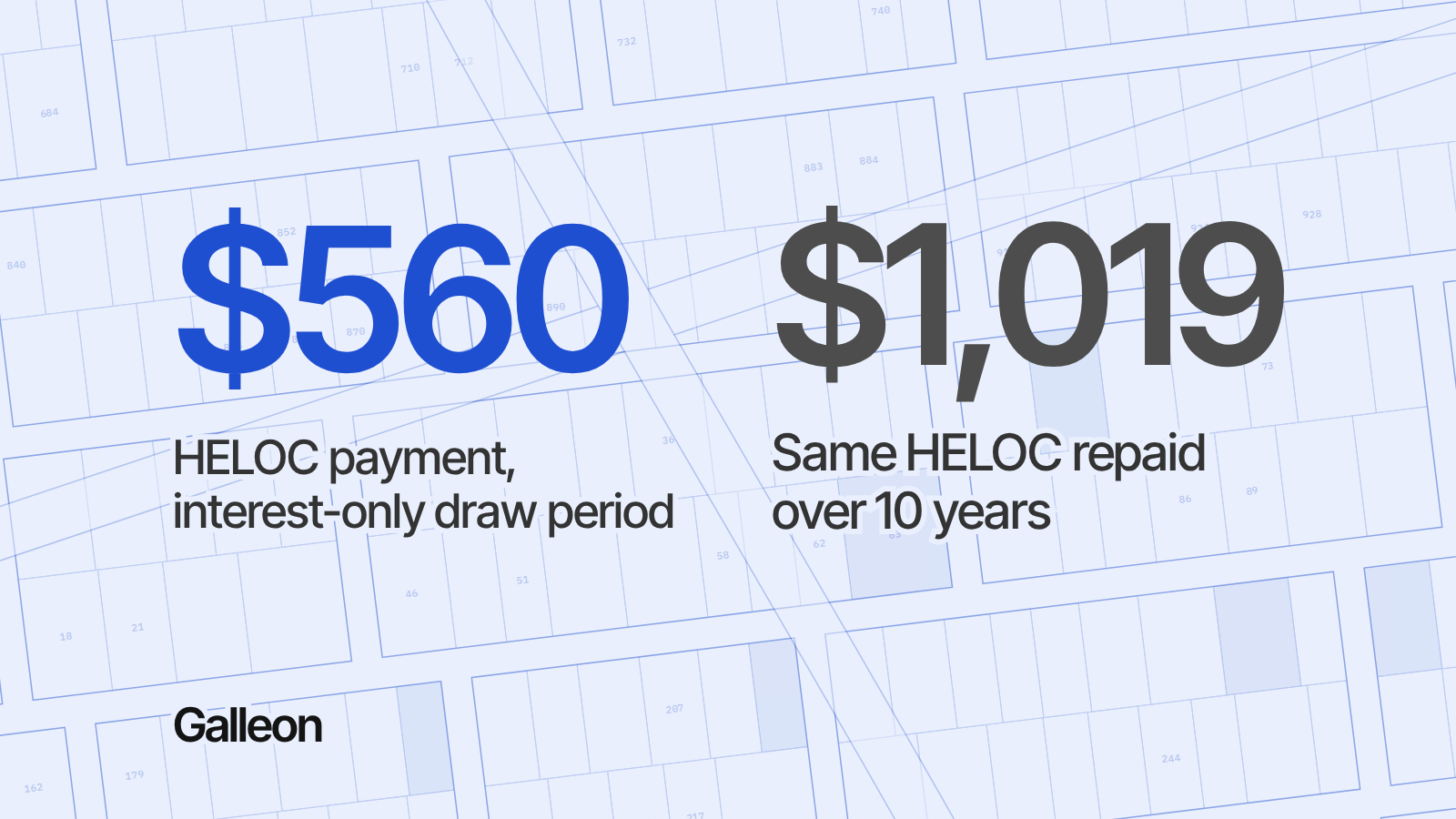
- In our example, an $84,000 HELOC draw costs $560 a month interest-only at 8%, then jumps to $1,019 a month if you repay it over 10 years.
- Using a HELOC plus a new mortgage can mean you've borrowed about 103% of the rental's price, with your own home on the line for part of it.
- If your debt-to-income ratio is already tight, a loan underwritten on the rental's rent may be a better fit than another payment on your personal credit.
Rates last updated November 9, 2026.
Will a lender accept HELOC money for a down payment?
For a conventional loan sold to Fannie Mae, yes. Fannie's Selling Guide allows borrowed funds secured by an asset, and real estate counts as an asset. Fannie's reasoning is that these funds "represent a return of equity," so you're spending your own money in a different form.
The lender still has to document where the money came from. Expect to provide:
- The terms of the HELOC (rate, payment, limit).
- Proof that the HELOC lender isn't a party to the sale.
- Proof that the money moved from the HELOC into your account.
Don't draw the money and shuffle it between accounts before you apply. A clean trail from the HELOC to your checking account to closing makes underwriting much easier.
How does the HELOC payment affect approval on the new loan?
This is the rule that decides most HELOC down payments. Under the same Fannie Mae guideline, the lender must add the HELOC's monthly payment to your debts. If your HELOC doesn't require a payment yet, the lender "must calculate an equivalent amount" anyway, so a quiet line still counts.
There's one exception worth knowing. Loans secured by financial assets, like a 401(k) loan or a loan against a brokerage account, don't have to be counted as a monthly debt under this rule. If you also count that same account toward your reserves, the lender reduces its value by what you borrowed plus fees. Fannie's broader rules on what counts are in its guide to monthly debt obligations.
In plain terms, a HELOC down payment raises your debt-to-income ratio the day you apply. If you're already close to your lender's limit, a $560 HELOC payment like the one in our example below can be what decides whether you qualify.
What do HELOC and mortgage rates look like right now?
Many HELOCs are priced at the prime rate plus a margin, and the margin depends on the lender and your credit. The Fed's H.15 release shows the bank prime rate at 7.00% as of November 6, 2026.
30-year and 15-year fixed mortgage averages Source: Freddie Mac PMMS, week of Nov 5, 2026
| Rate | As of Nov 2026 | A year earlier |
|---|---|---|
| 30-year fixed mortgage | 7.18% | 6.22% |
| 15-year fixed mortgage | 6.57% | 5.50% |
These averages come from Freddie Mac's weekly survey, which describes a borrower with good to excellent credit, 20% down, buying an owner-occupied home. A rental will usually price higher than that, so don't plug 7.18% into your rental math without checking with your lender.
Worked example: a HELOC down payment on a $300,000 rental
Let's run the numbers for an investor with a few doors who wants to buy a $300,000 single-family rental. Every input marked "assumption" is ours. Change them to your own loan terms before you rely on any of this.
Example: HELOC-funded rental purchase Assumptions: 80% max combined loan-to-value on your home, prime + 1% HELOC, PMMS + 0.75% for an investment-property rate. Rates as of Nov 2026 (Fed H.15, Freddie Mac PMMS).
| Input | Value | Note |
|---|---|---|
| Your home's value | $500,000 | Example |
| First mortgage balance | $300,000 | Example |
| HELOC line available (80% CLTV) | $100,000 | Assumption, varies by lender |
| HELOC rate | 8.00% | Prime 7.00% + 1% margin (assumption) |
| Rental purchase price | $300,000 | Example |
| Down payment (25%) | $75,000 | Conservative; your minimum may be lower |
| Closing costs (about 3%) | $9,000 | Assumption; use your Loan Estimate |
| HELOC draw | $84,000 | Down payment + closing costs |
| New rental mortgage | $225,000 | 30-year fixed |
| Rental mortgage rate | 7.93% | PMMS 7.18% + 0.75% (assumption) |
Here's what that costs each month.
Example: monthly payments Same assumptions as above
| Payment | Monthly |
|---|---|
| Rental mortgage, principal and interest at 7.93% | $1,640 |
| Same loan at the owner-occupied 7.18% average | $1,524 |
| HELOC interest-only at 8.00% | $560 |
| HELOC interest-only at 7.50% | $525 |
| HELOC interest-only at 8.50% | $595 |
| Rental mortgage + HELOC (8.00%) | $2,200 |
Now look at the total debt. You borrowed $84,000 on the HELOC and $225,000 on the mortgage, which is $309,000 against a $300,000 property, or about 103% of the purchase price. Your home now carries $384,000 of debt on a $500,000 value, a combined loan-to-value of 76.8%.
Watch out: With a HELOC down payment, you can owe more than the rental is worth on day one, and part of that debt sits on the home you live in.
Does the rental cover both loans?
The rent has to pay for more than the mortgage. In our example, it needs to clear $2,200 a month in loan payments, and that's before property taxes, insurance, vacancy and repairs. If the rental only covers its own mortgage, your paycheck covers the HELOC.
Run a full rental property cash flow analysis and treat the HELOC payment as a line item, the same as the mortgage. It's easy to leave it out because it's "on the house," and that makes the rental look better than it is.
If you're screening a lot of listings, Operator (the system of record for your properties) runs two agents, the Buy Box Agent and the Rent Monitoring Agent. The Buy Box Agent screens new listings in your markets overnight, pulls county tax bills, insurance estimates and rent comps for each one, and runs cash flow at your financing terms. Subtract your HELOC payment from that cash flow and you'll see quickly whether the deal still works.
What happens when the HELOC draw period ends?
Most HELOCs start with a draw period where you can pay interest only. When it ends, you stop drawing and start paying back the balance with interest. If your line has a 10-year draw, this is the "what happens after 10 years" moment, and the payment jump can be large.
Example: $84,000 HELOC at 8.00%, before and after the draw period Rental mortgage at 7.93%, $1,640 a month
| Phase | HELOC payment | Rental mortgage + HELOC |
|---|---|---|
| Draw period, interest-only | $560 | $2,200 |
| Repay over 20 years | $703 | $2,343 |
| Repay over 10 years | $1,019 | $2,659 |
On a 10-year repayment, the HELOC payment rises by $459 a month. Because the rate is variable, those numbers also move whenever prime moves. Pick your plan before you draw:
- Pay the balance down during the draw period.
- Refinance the balance before repayment starts.
- Make sure the rental's cash flow can absorb the higher payment.
Why does a HELOC get harder with each property you add?
Every HELOC payment stays on your debt-to-income ratio for the next loan too. If you're trying to grow to 20+ doors, each new agency loan gets tougher to qualify for, because the HELOC payment and every rental mortgage stack up on your personal credit. That's the trap for investors who use the same move twice.
Self-employed investors, people with several financed properties and anyone already near their DTI limit feel this first. Before you choose a path, map out how the next two or three purchases will be financed. Our guide on building a rental portfolio walks through how financing changes as you add doors.
HELOC alternatives for a down payment
None of these is free money. Each one trades one problem for another, so compare them on the same deal.
| Option | What it uses | What to watch |
|---|---|---|
| DSCR loan on the rental | The rental's rent vs. its payment | Rate and down payment vary by lender; compare to an agency loan |
| 401(k) or brokerage-secured loan | Your financial assets | Fannie doesn't count the payment as debt, but it cuts your reserves |
| Cash-out refi on another rental | Equity in a property you already own | Resets that loan at today's rates |
| Savings or a partner's cash | Your cash or someone else's | Slower, or you share the profit |
| Reduced-documentation equity loan | Home or rental equity | Terms vary widely; get every fee in writing |
A DSCR loan is often where investors land once their DTI is maxed out, because the lender looks at whether the rental's rent covers its own payment. It doesn't solve the down payment by itself, but the new mortgage is judged on the property's income instead of yours.
"No doc" or low-doc equity products exist, but they aren't standardized. Before you sign, get these in writing:
- The rate, the margin and the index it follows.
- The draw period, the repayment period and any balloon payment.
- Origination fees, annual fees and minimum draw rules.
- Whether the lien is on your home or on a rental.
If the rental can't carry its mortgage and the HELOC payment, you've taken a second mortgage on your home that your paycheck has to pay.
How do taxes work on HELOC interest?
It depends on how you use the money, and the rules for your home can differ from the rules for a rental. Ask your CPA how the interest will be treated before you draw, and keep the HELOC money on a clean trail from the line to the closing table so it's easy to trace later.
This is general information, not tax, legal or lending advice. Talk to your CPA, attorney or lender about your situation.
FAQ
Can I use a HELOC for a down payment on an investment property?
Yes. Fannie Mae allows borrowed funds secured by real estate, including a HELOC on your home, as a source for the down payment, closing costs and reserves. Your lender will document the HELOC terms, confirm the HELOC lender isn't part of the sale, and verify the money was transferred to you.
Does the HELOC payment count against my debt-to-income ratio?
Yes. The new lender must include the HELOC payment in your monthly debts. If the line doesn't require a payment, the lender has to calculate an equivalent amount.
What happens to a HELOC after the draw period ends?
You stop drawing and start repaying principal plus interest. In our example, an $84,000 balance at 8% goes from $560 a month interest-only to $703 over 20 years or $1,019 over 10 years. Since most HELOC rates are variable, the payment can also move with prime.
What is the payment on a $50,000 HELOC?
At 8%, about $333 a month interest-only. If you repay it over 20 years, it's about $418 a month, and over 10 years it's about $607.
What's a good HELOC alternative if my DTI is maxed out?
Many investors look at a DSCR loan, which qualifies the rental on its own rent instead of your personal income. A loan secured by a 401(k) or brokerage account is another option, since Fannie doesn't count that payment as monthly debt, though it reduces your reserves.
Is HELOC interest tax deductible if I use it to buy a rental?
It depends on how the money is used, so ask your CPA before you draw.