Yes, you can get a HELOC on an investment or rental property, but fewer lenders offer one and the terms are tighter: most cap your total loans at 70% to 75% of the property's value and charge more than they would on your own home. If you're holding a low-rate first mortgage, a rental HELOC can still cost hundreds of dollars a month less than a cash-out refinance, as long as you can carry a payment that floats.
Key takeaways
- Lenders that offer investment-property HELOCs often cap combined loans at 70% to 75% of the property's value, according to Chase as of July 2026.
- HELOC rates float with the prime rate, which was 7.00% as of November 5, 2026, plus a lender margin that runs higher on rentals than on your own home.
- In our example, keeping a 3.25% first mortgage and adding a $62,000 HELOC costs about $585 a month less than a cash-out refi during the draw period.
- The HELOC payment can jump when the draw period ends, so price it with principal added and at a higher rate before you sign.
- A HELOC on your primary home used to buy a rental is a different loan, with looser limits and more personal risk.
- The IRS allows a deduction for interest used to produce rents, so keep a record of where every dollar of the draw goes.
Last updated November 7, 2026. Rates shown are as of November 5, 2026, and they change often.
Can you get a HELOC on a rental property?
Yes, but plan on shopping around. Chase says some lenders don't offer investment-property HELOCs at all, and those that do may limit how many financed properties you can have. Credit unions are worth a call. Quorum Federal Credit Union, for example, offers an investment property HELOC on non-owner-occupied 1-4 unit homes, condos and townhouses, in first or second lien position.
A HELOC is an open-end line of credit. You draw what you need and pay interest only on what you've drawn, not on the whole line. The CFPB notes the draw period could last 10 years, with repayment often stretched over 10 or 20 years after that.
Is it a HELOC on the rental or on your home?
People use the phrase for two different loans, and the limits aren't the same.
HELOC on a rental vs. HELOC on your home Typical terms. Lenders vary.
| HELOC on the rental | HELOC on your primary home | |
|---|---|---|
| What secures it | The rental | The house you live in |
| Max combined loan-to-value | 70% to 75% | Up to 80% in Chase's example |
| Equity left after the line | 25% to 30% | About 20% |
| Rate | Higher | Lower |
| If payments slip | The rental is at risk | Your home is at risk |
Source: Chase, "Can you buy an investment property with a HELOC?", last edited July 3, 2026.
The home HELOC is easier to get and usually cheaper. The CFPB is plain about the catch: falling behind can mean losing your home, which is a real cost hiding behind the lower rate. The rest of this post focuses on a HELOC secured by the rental itself.
What do lenders want for an investment property HELOC?
Based on Chase's guidance, expect a lender to look for:
- Combined loans of no more than 70% to 75% of the appraised value.
- A debt-to-income ratio that generally stays below 43%.
- A higher credit score than they'd ask for on a primary home.
- A review of the rental's cash flow.
Ask about fees too. The CFPB's HELOC booklet notes some plans require a minimum draw (such as $300) or a draw at closing. Get the appraisal fee, annual fee and any early-closure fee in writing before you pay for anything.
What does a rental HELOC cost right now?
Your HELOC rate is the prime rate plus the lender's margin. Prime was 7.00% every day from October 30 to November 5, 2026, according to the Federal Reserve's H.15 release. The Fed defines it as the rate posted by a majority of the top 25 U.S. commercial banks, and when prime moves, your HELOC rate moves with it.
The margin is where rental pricing shows up. Lenders rarely publish it for investment HELOCs, so you'll only see it on a quote.
For the refinance side, the Freddie Mac survey put the 30-year fixed at 7.18% as of November 5, 2026, compared with 6.22% a year earlier. That survey covers owner-occupied purchase loans with 20% down and excellent credit, so don't expect that rate on a rental.
Prime is public. The margin on top of it is the number you shop for.
Worked example: keep your 3.25% loan or do a cash-out refi?
Example. You own four doors and want cash for the down payment on a fifth. One single-family rental is worth $400,000. You financed it in mid-2021 with a $270,000, 30-year fixed loan at 3.25%. After 66 payments, the balance is about $238,000 and principal and interest run $1,175.06 a month.
Step 1: Find your maximum line
Multiply the value by the lender's cap, then subtract what you owe. At 75%, that's $400,000 × 0.75 = $300,000, minus $238,000, for a $62,000 line. If your lender caps you at 70%, the line drops to $42,000. Don't forget to swap in your own value, balance and cap.
Step 2: Price the HELOC payment
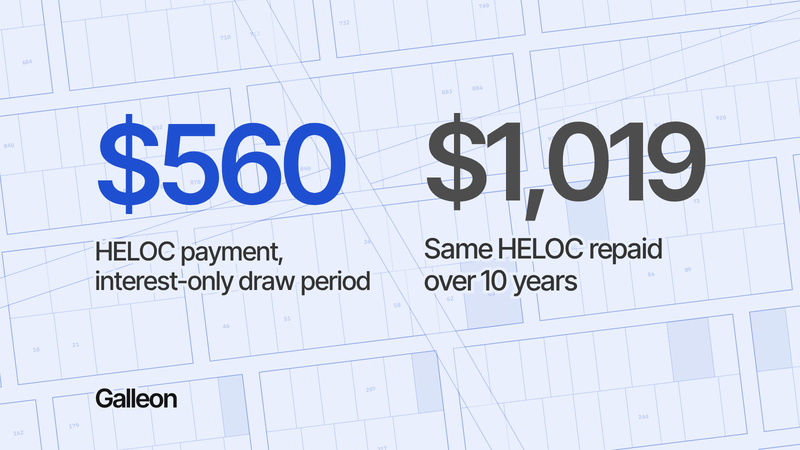
We'll assume a margin of 1.25 points, so 7.00% prime + 1.25% = 8.25%. That margin is our guess, so replace it with your quote. During the draw period most HELOCs let you pay interest only: $62,000 × 8.25% ÷ 12 = $426.25 a month. If you only draw $50,000, it's $343.75.
Step 3: Compare it with a cash-out refi
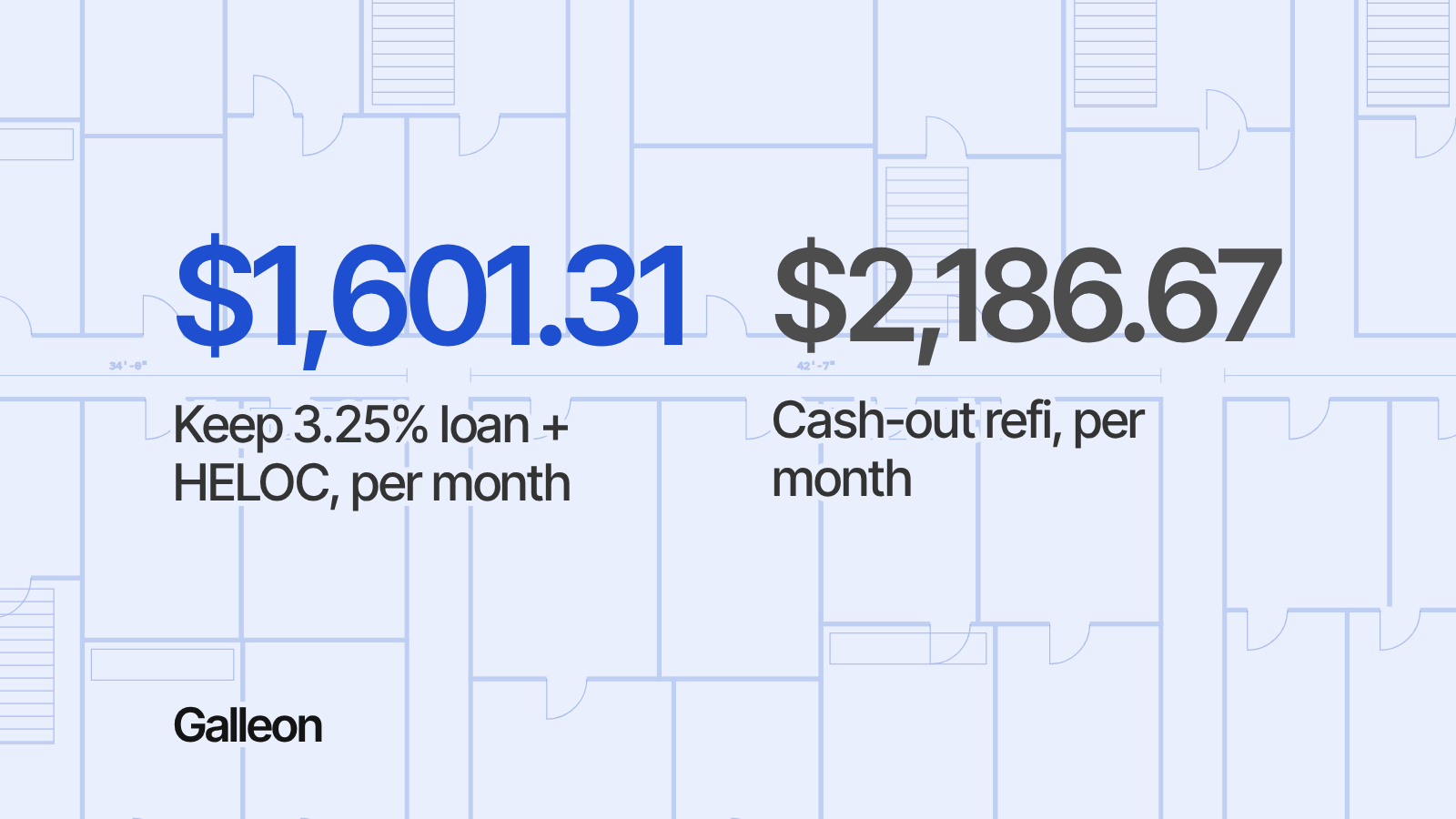
A cash-out refi to 75% replaces the whole $238,000 loan with a new $300,000 loan, giving you the same $62,000 before closing costs. At the survey's 7.18%, the payment would be $2,032.30. Rentals price higher, so we add an assumed 0.75-point premium, for 7.93% and $2,186.67 a month.
Monthly cost of pulling $62,000 out Example. $400,000 rental, 30-year refi at an assumed 7.93%, HELOC at an assumed 8.25% interest-only.
| Keep 3.25% loan + HELOC | Cash-out refi | |
|---|---|---|
| First mortgage payment | $1,175.06 | $2,186.67 |
| HELOC payment | $426.25 | $0 |
| Total per month | $1,601.31 | $2,186.67 |
| Cash out, before costs | $62,000 | $62,000 |
| Rate type | 3.25% fixed + variable line | 7.93% fixed |
Rates: Federal Reserve H.15 prime and Freddie Mac PMMS, as of November 5, 2026. Margin and investment premium are assumptions.
The HELOC route costs about $585 a month less. Even after the draw period ends and the HELOC starts paying down principal at $528.28 a month (20-year repayment), the total is $1,703.34, still about $483 below the refi.
The refi does two things the HELOC doesn't: it locks a fixed rate, and it pays down principal from day one. With the HELOC, the payment floats with prime, and interest-only means the $62,000 isn't shrinking. Before you commit, plug the HELOC payment into the rental property calculator alongside door #5's numbers.
What happens if prime rises or the draw period ends?
Say you've drawn $50,000 of the line. Here's how the payment moves.
Payment on a $50,000 HELOC draw Example. Margin of 1.25 points over prime. Amortizing payment assumes a 20-year repayment period.
| Prime | HELOC rate | Interest-only | 20-year amortizing |
|---|---|---|---|
| 7.00% (as of Nov 5, 2026) | 8.25% | $343.75 | $426.03 |
| 8.00% | 9.25% | $385.42 | $457.93 |
| 9.00% | 10.25% | $427.08 | $490.82 |
Source for prime: Federal Reserve H.15, November 5, 2026. Higher prime rows are what-ifs, not forecasts.
Watch out: If prime is 2 points higher when your draw period ends, the payment on that $50,000 goes from $343.75 to $490.82, about 43% more. Make sure the rental can carry the higher number.
How does a rental HELOC affect your next loan?
The draw is new debt, and your next lender will see it. On a conventional loan it counts against your debt-to-income ratio. Ask the lender whether they count the payment on the full line or only what you've drawn, because that changes how much room you have.
If you plan to use a DSCR loan on the next property, that property's rent has to cover its own payment. Meanwhile, the existing rental now carries about $426 more each month.
So run a fresh rental cash flow analysis on that property with the HELOC payment included, and make sure it still pays for itself.
Chase also notes some lenders cap how many financed properties you can have. If you plan to grow to 10, 20 or more doors, ask about that limit early. It's part of building a real estate portfolio without boxing yourself in.
Is HELOC interest deductible on a rental property?
The IRS says interest you incur to produce rents is deductible, though it may be limited, and points to Publication 527 for rental property. Publication 527 treats home equity loan money spent on things like paying off credit cards, buying a car or paying tuition as not benefiting the rental.
The practical move is to put HELOC draws in a separate account and write down what each one paid for. That record matters most when a HELOC on your home funds a rental, or a HELOC on a rental funds something personal. Your CPA will want to see it either way.
How to apply for a HELOC on a rental
- Run the equity math at both 75% and 70% so you know your range.
- Call banks and credit unions, and ask each one the questions below.
- Pull together your mortgage statements, insurance, leases and tax returns. If you track what you own in Operator, you can export a lender-ready PDF of each property for the cash-flow review instead of rebuilding it by hand.
- Get a cash-out refi quote on the same property so you're comparing real numbers.
- Price the HELOC at today's rate, at 2 points higher, and with principal added.
Questions to ask each lender:
- Do you lend on non-owner-occupied property?
- What's your max combined loan-to-value?
- What's your margin over prime?
- What fees come with the line?
- Does the property have to be in my personal name?
This is general information, not tax, legal or lending advice. Talk to your CPA, attorney or lender about your situation.
FAQ
Can I get a HELOC on a rental held in an LLC?
Ask each lender before you pay for an appraisal. Title rules vary from lender to lender, and some home equity programs only lend on properties in your personal name.
What's the monthly payment on a $100,000 home equity loan?
At an example fixed rate of 8.25%, it's about $1,226.53 over 10 years, $970.14 over 15 years, or $852.07 over 20 years. Swap in your own quote, since investment-property rates vary by lender.
Can I use a HELOC on my home to buy a rental?
Yes. Chase notes you can use a primary-home HELOC toward an investment purchase, and limits are often looser than on a rental. Some credit unions, such as Quorum, can also open a HELOC on the investment property at the same time as the purchase mortgage to cover the down payment. Just remember that a home HELOC puts the house you live in on the line.
What happens to the HELOC if I sell the rental?
You'll generally have to pay it off in full when you sell, according to the CFPB. Plan for it in your sale math.
Is a HELOC or a home equity loan better on an investment property?
A home equity loan gives you a lump sum at a fixed rate, which is easier to budget. A HELOC lets you draw only what you need, but the rate floats with prime. If you know the exact amount and want a steady payment, the loan fits; if you're not sure when you'll need the cash, the line does.