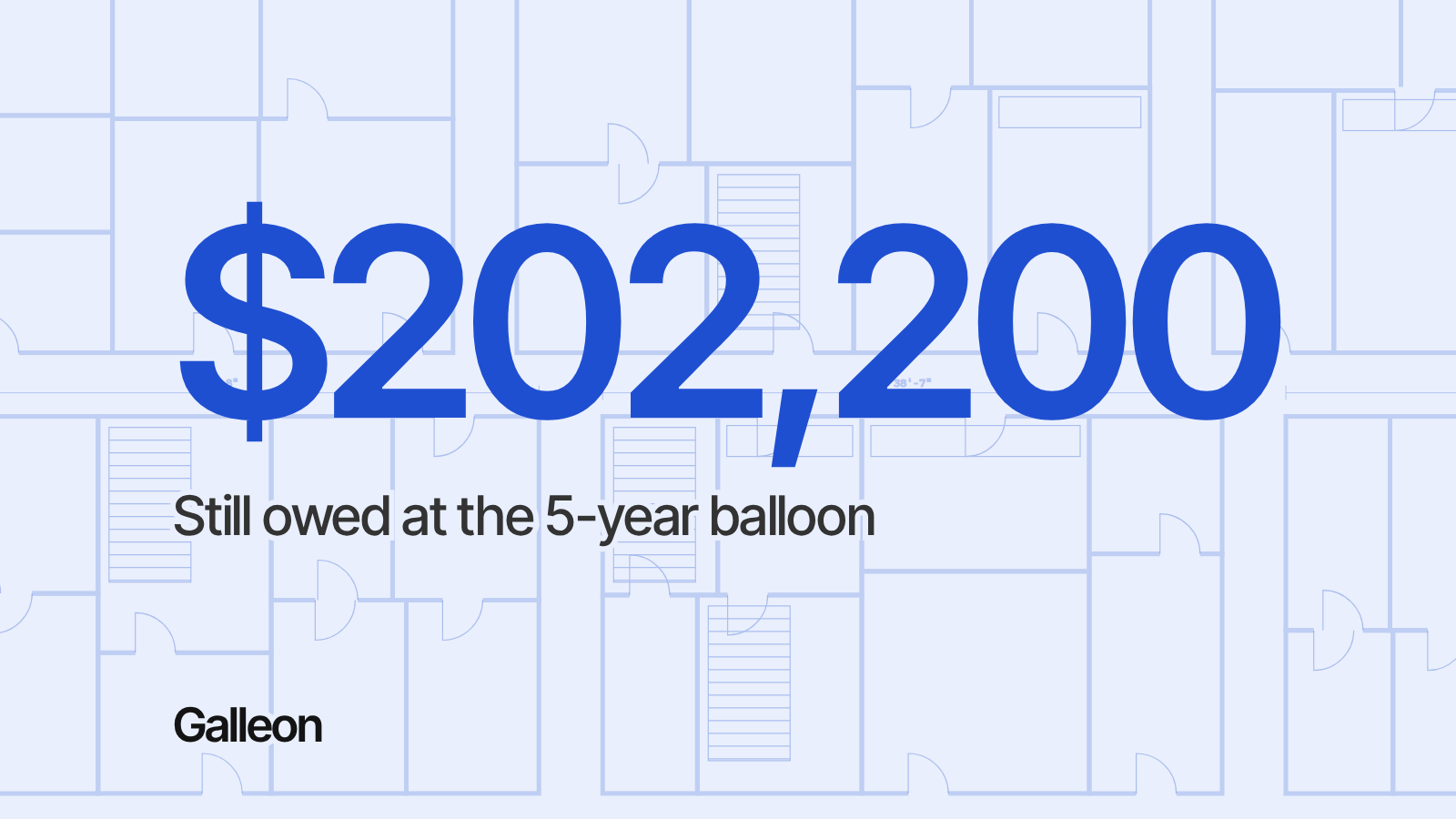
To calculate a seller financing payment, use the same amortization formula a bank uses: payment = P × r ÷ (1 − (1 + r)^−n), where P is the note amount, r is the annual rate divided by 12 and n is the number of months. A $216,000 note at 6.5% amortized over 30 years comes to $1,365.27 a month, and with a 5-year balloon the buyer still owes about $202,200 when it comes due.
Key takeaways
- A seller financing payment uses the standard amortization formula, so one spreadsheet cell can check any online calculator.
- On a 5-year balloon, the buyer in our example pays $68,116 in interest and only about $13,800 in principal, then still owes about $202,200.
- The IRS sets a floor for the note rate, and as of November 2026 the applicable federal rates are 4.67% short-term, 5.08% mid-term and 5.52% long-term.
- Under the CFPB's three-property exclusion, a seller-financed note on a home must fully amortize, so a balloon only fits the narrower one-property exclusion.
- Sellers pay tax on gain as principal arrives, so in our example $26,414 of principal received in year 1 creates $9,905 of taxable gain.
What numbers do you need for a seller finance calculation?
You need five terms from the deal: the price, the down payment, the note rate, the amortization period and the balloon date, if there is one. If the buyer will rent the property out, add monthly taxes, insurance and expected rent so you can test whether the payment works. Here's the example we'll use throughout; the numbers are made up, so swap in your own.
| Input | Example |
|---|---|
| Purchase price | $240,000 |
| Down payment (10%) | $24,000 |
| Note amount | $216,000 |
| Note rate | 6.50% |
| Amortization | 30 years (360 months) |
| Balloon | Month 60 (5 years) |
| Taxes and insurance | $250 + $150 a month |
| Market rent | $2,000 a month |
Example, not a quote.
Don't mix up amortization and the balloon. Amortization sets the payment as if the loan ran all 30 years, while the balloon is the date the seller wants the rest of the money, usually much sooner.
How do you calculate the monthly payment?
Here's how to run M = P × r ÷ (1 − (1 + r)^−n) by hand:
- Divide the annual rate by 12 to get the monthly rate: 6.5% ÷ 12 = 0.0054167.
- Multiply the years of amortization by 12: 30 × 12 = 360 months.
- Plug both into the formula: $216,000 × 0.0054167 ÷ (1 − 1.0054167^−360).
- Read the result: $1,365.27 a month, principal and interest only.
In Excel or Google Sheets, `=PMT(0.065/12, 360, -216000)` returns the same $1,365.27. Don't forget to change the rate, term and loan amount to your own deal before you trust the answer.
To build this into a full sheet with income and expenses, see our deal analysis spreadsheet guide.
How does each payment split between interest and principal?
Each month, interest equals the prior balance times the monthly rate, and whatever is left of the payment goes to principal. Early on, that's a small slice.
| Month | Interest | Principal | Balance after payment |
|---|---|---|---|
| 1 | $1,170.00 | $195.27 | $215,804.73 |
| 2 | $1,168.94 | $196.33 | $215,608.40 |
| 3 | $1,167.88 | $197.39 | $215,411.01 |
Example: $216,000 at 6.5%, 30-year amortization.
If your spreadsheet matches these three rows, it's built right. By the end of year 1, the buyer has paid about $13,969 in interest and $2,414 in principal, leaving a balance of $213,585.71.
How do you calculate the balloon payment?
The balloon is the loan balance on the day it comes due. The balance after k payments is:
B = P × (1 + r)^k − M × ((1 + r)^k − 1) ÷ r
For our note, k is 60 and the balance comes to about $202,200. In a spreadsheet, `=FV(0.065/12, 60, 1365.27, -216000)` gets you there in one cell.
Over those five years the buyer sends the seller about $81,916, but only about $13,800 of it pays down principal. The other $68,116 is interest.
After five years of on-time payments, the buyer still owes about 94% of the original note.
Two common tweaks change the picture:
- Interest-only: the payment drops to $1,170 a month, and the full $216,000 is due at the balloon.
- 7-year balloon: two more years of payments only bring the balance down to $195,299.
What interest rate should a seller-financed note carry?
The floor comes from the IRS. IRS Publication 537 warns that if the agreement doesn't state enough interest, "there may be unstated interest or original issue discount (OID)." That can make the seller report interest in a year they didn't receive any.
The test rates are the applicable federal rates (AFRs), which the IRS publishes every month. As of November 2026, Rev. Rul. 2026-21 sets them at 4.67% short-term, 5.08% mid-term and 5.52% long-term (annual compounding). Which one applies depends on the note's term, so check the ruling for the month you sign with your CPA.
The benchmark is the bank market. Freddie Mac's 30-year fixed average was 7.28% as of November 19, 2026, up from 6.26% a year earlier. That's an average for home mortgages, and investor loan quotes often land somewhere else.
| Rate | Monthly payment | Balloon at month 60 | 5-year interest |
|---|---|---|---|
| Mid-term AFR, 5.08% | $1,170.12 | $198,574 | $52,781 |
| Long-term AFR, 5.52% | $1,229.14 | $199,768 | $57,516 |
| Our note rate, 6.50% | $1,365.27 | $202,200 | $68,116 |
| Freddie Mac average, 7.28% | $1,477.90 | $203,921 | $76,595 |
Example: $216,000 note, 30-year amortization, 5-year balloon. AFRs from Rev. Rul. 2026-21 (November 2026); Freddie Mac PMMS as of Nov 19, 2026.
Going from the mid-term AFR to the Freddie Mac average adds $307.78 to the monthly payment and $23,814 of interest over five years, but the balloon only grows by $5,347. The rate moves the buyer's monthly cash flow far more than what's owed at the end.
Can the buyer afford it? Run a DSCR check
If the buyer will rent the property out, test the payment the way a lender would: divide rent by the note payment plus taxes and insurance. Our example comes to $1,365.27 + $250 + $150 = $1,765.27 a month. Against $2,000 of rent, that's a debt service coverage ratio of 1.13, so rent covers the payment with only 13% to spare.
If the buyer plans to refinance into a DSCR loan and that lender wants 1.25, rent would need to be about $2,207. Sellers should run this check too, because a buyer who can't cover the payment may not pay the note.
DSCR only looks at the debt. A full cash flow analysis adds vacancy, repairs and management, which tightens the picture further.
What happens when the balloon comes due?
The buyer usually pays the balloon by refinancing or selling. Refinancing $202,200 at 7.28% over 30 years would cost about $1,383 a month, only $18 more than the seller-financed payment. That assumes the buyer qualifies, the property appraises and rates sit where they are now, and nobody knows where they'll be in five years.
Watch out: If the buyer can't refinance or sell by the balloon date, both sides have a problem. Agree on a plan B in writing before closing, such as an extension option at a set rate.
Start the refinance prep a year or so before the balloon. If you track the property in Operator, our system of record for what you own, you can export a lender-ready PDF when it's time to shop the loan.
When is a balloon allowed under CFPB rules?
Federal lending rules (Regulation Z) can treat a seller who finances a home like a loan originator. The CFPB's compliance guide lays out two exclusions, and only one of them leaves room for a balloon.
| Rule | One-property exclusion | Three-property exclusion |
|---|---|---|
| Who it covers | A natural person, estate or trust | Any seller |
| How many sales | One property in 12 months | Three or fewer in 12 months |
| Balloon allowed? | Yes, with no negative amortization | No, the note must fully amortize |
| Rate | Fixed, or adjusts after 5+ years | Fixed, or adjusts after 5+ years |
| Other conditions | Seller owned the property and isn't the builder | Good-faith judgment that the buyer can repay |
Source: CFPB Loan Originator Rule Small Entity Compliance Guide, November 2019.
So if you seller-finance two homes in the same 12 months, a 5-year balloon puts you outside both exclusions. The rule itself is 12 CFR 1026.36(a)(4).
These rules are written for credit secured by a dwelling. Whether they apply when you sell a rental to another investor or an LLC is a question for your attorney, along with your state's rules on interest caps and land contracts.
If you still have a mortgage on the property, read your loan documents before you agree to carry a note. That's one reason buyers hoping for seller financing look for owners who hold free and clear, such as landlords getting ready to retire. Our guide on finding off-market properties covers how buy-and-hold investors reach them.
How is the seller taxed on the payments?
The IRS calls this an installment sale: "a sale of property where you receive at least one payment after the tax year of the sale." The seller reports the gain as principal comes in, instead of all in year 1. Here's the Pub 537 method:
- Find the installment basis: adjusted basis plus selling expenses plus any depreciation recapture. In our example, $140,000 + $10,000 = $150,000 (we're leaving recapture out to keep it simple).
- Find the gross profit: $240,000 − $150,000 = $90,000.
- Find the contract price. The buyer isn't assuming any debt, so it's the full $240,000.
- Divide: $90,000 ÷ $240,000 = a 37.5% gross profit percentage.
- Apply it to every dollar of principal, including the down payment. The rest is a tax-free return of basis.
In year 1, the seller receives $24,000 down plus $2,414.29 of principal, or $26,414.29. At 37.5%, $9,905.36 of that is taxable gain, and the $13,969 of interest is taxed separately as ordinary income. When the buyer pays the balloon in year 5, about $75,825 of gain lands in that year, and by payoff the seller has reported the full $90,000.
Two things can change this math. Depreciation on a rental may have to be recaptured as ordinary income, and Pub 537 adds that recapture to the basis in step 1, which changes the percentage. Dealers (think frequent flippers) also can't use the installment method on property held for sale to customers, so check with a CPA first.
Last updated November 20, 2026. Mortgage rates change weekly and AFRs change monthly, so check the current figures before you set terms.
This is general information, not tax, legal or lending advice. Talk to your CPA, attorney or lender about your situation.
FAQ
Is a seller financing payment calculated the same way as a mortgage payment?
Yes. It uses the standard amortization formula, and `=PMT(rate/12, months, -loan amount)` does the same thing in a spreadsheet. What's different with seller financing is the terms: the rate, down payment and balloon date are whatever the buyer and seller agree to.
What is the minimum interest rate for seller financing in November 2026?
As of November 2026, the IRS applicable federal rates are 4.67% short-term, 5.08% mid-term and 5.52% long-term (annual compounding), per Rev. Rul. 2026-21. Stating too little interest can create unstated interest the seller must report, even in a year with no payment. Which rate applies depends on the note's term, so confirm it with your CPA.
How do I calculate the balloon payment in a spreadsheet?
Use the FV function with the monthly rate, the number of payments made, the payment and the loan amount as a negative number. For our example, `=FV(0.065/12, 60, 1365.27, -216000)` returns about $202,200 owed at month 60.
Can a seller who finances more than one property a year use a balloon?
Not under the three-property exclusion, which requires a fully amortizing note. A balloon fits only the one-property exclusion, for a natural person, estate or trust financing one property in 12 months. Ask your attorney how this applies to your sales.
Does the seller pay tax on the down payment?
Yes. In our example, $24,000 down at a 37.5% gross profit percentage means $9,000 of taxable gain in the year of sale.